
A US patient with severe alveolar ridge resorption and lost vertical dimension — why replacing her dentures wasn't enough, and how a staged treatment plan finally addressed the real problem
Patient name has been changed to protect privacy. This article reflects one individual's experience and does not represent a typical outcome.
She Came In Asking for New Dentures
Emma Johnson, 45, came to us from the United States with a straightforward request: she wanted a new set of complete dentures.
Her existing upper and lower full dentures had been in place for 15 years. In the beginning, they worked well enough. Over time, that changed. Chewing became less efficient. Her smile started to look less natural. The support around her lips and lower face gradually softened. By the time she reached out, the dentures weren't just old — they had stopped doing their job.
For many patients, some loosening and wear after years of use feels like a normal part of having dentures. But Emma had noticed something more than that. Her bite felt increasingly unstable. Her face looked more sunken than it used to. She was losing confidence eating and speaking in everyday situations. The dentures weren't just worn — they were no longer holding up her daily life.
Patient Overview
📋 Table 1 — Patient Summary
Why a New Removable Denture Alone Wouldn't Have Solved the Problem
The instinctive response to worn dentures is simple: make new ones. But Emma's situation was more complicated than that.
Her problem wasn't just that the dentures were old. The underlying foundation had changed significantly. After years of complete tooth loss and long-term denture use, the alveolar ridges — the bony structures that support the dentures — undergo continuous resorption. As the ridges shrink, the occlusal relationship shifts, vertical dimension decreases, and facial support gradually collapses. The prosthetics sitting on top of that foundation can only do so much.
This is why some patients find that even after getting new dentures made, the same problems return within a few years. The prosthesis changes, but the foundation doesn't. Research on complete denture longevity and ridge resorption rates supports this pattern: bone loss under dentures is a progressive process, and its effects accumulate over time.2,32,3
For Emma, simply fabricating a new set of removable dentures — without addressing the occlusal relationship, vertical dimension, and support deficits — would likely have carried most of her existing problems forward in a different form.
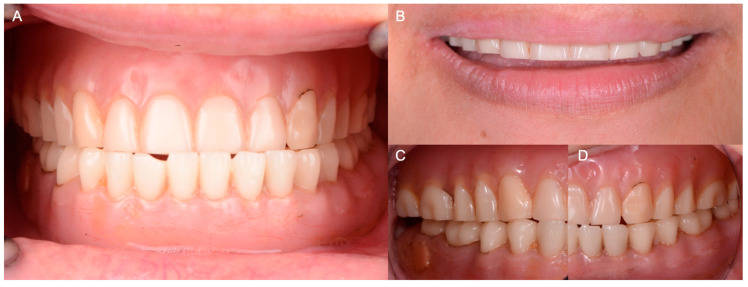
Fig. 1 — Emma's existing complete dentures at initial consultation. After 15 years of use, both prostheses showed significant wear, aging, and functional decline.
Three Options Were on the Table
Before any treatment began, the treating physician walked Emma through the realistic options available to her — not just the ideal scenario, but the full range of paths with different clinical and financial implications.
Option 1 — New conventional complete removable dentures for both arches.
Option 2 — Implant-supported overdentures for both arches.
Option 3 — Fully fixed implant-supported full-arch restoration for both upper and lower jaws.
From a purely clinical standpoint, more fixed support generally means better stability and function. But real treatment decisions don't happen in a textbook. They happen within the constraints of bone availability, patient health, and what a person can realistically commit to — financially and logistically.
After reviewing the options, Emma chose a hybrid path: maxillary complete removable denture combined with mandibular fixed implant-supported full-arch restoration.
This wasn't a fallback. It was a deliberate, clinically grounded decision. Fixed implant support in the lower arch would meaningfully improve stability and chewing efficiency — the area where the functional deficit was most significant. The upper arch, where ridge resorption was also pronounced, would be addressed with a new well-fitted removable denture that restored lip support, vertical dimension, and esthetics. The plan prioritized the most impactful improvements within a realistic budget.
Why She Didn't Move Forward in the United States
This part of Emma's story is worth understanding clearly, because it gets at something many international patients experience.
She had consulted with dental providers in the US — more than once. The conversations weren't unhelpful, but they tended to stop at one of two places: "You can get new dentures made" or "If your budget allows, there are more complex options." What she never received was a complete, sequenced explanation of what was actually happening and what the right order of treatment should be:
Was this just denture aging, or had the bone loss already reached a point where the whole occlusal foundation needed to be rebuilt?
If fixed restoration was worth pursuing, where should it start, and why?
Which parts of the reconstruction were worth prioritizing now, and which could be staged later?
What did a plan that was both clinically sound and financially realistic actually look like?
Looking back, Emma said her hesitation wasn't about whether to get treatment. It was that she had never walked away from a consultation with a clear enough picture to make a decision.
That changed when she connected with the Beijing-based clinical team through PandaMed's online consultation process. PandaMed coordinated the initial case review — helping organize her records, facilitate communication, and translate the clinical discussion — so that the treating physicians could assess her situation in full before she traveled.
What the physicians told her wasn't a sales pitch. It was a breakdown of the problem in sequence:
Your issue isn't just worn dentures. The ridge resorption is significant on both arches, and both the occlusal relationship and facial support need to be re-established from the ground up. Jumping straight to "what prosthetic do you want at the end" puts the cart before the horse. The right starting point is to redefine the occlusal foundation first — then determine where fixed restoration delivers the most value.
That explanation was the turning point. Emma's decision to travel to Beijing wasn't driven by the idea that the US couldn't do the work. It was driven by the fact that, for the first time, she had a treatment logic she could actually follow — one that was clear, sequenced, and matched her real situation.
Why the Hybrid Plan Made Clinical Sense
Emma's choice of upper removable denture plus lower fixed implant restoration didn't represent a lowering of expectations. It represented a physician-guided prioritization based on where the clinical need was greatest.
Upper arch: Significant ridge resorption made a new, properly fitted complete removable denture the appropriate starting point — to restore lip support, re-establish vertical dimension, and improve esthetics without requiring bone augmentation procedures.
Lower arch: Within the available bone volume, four implants placed interforaminally (between the mental foramina) could support a fixed full-arch restoration — meaningfully improving stability, retention, and chewing efficiency in the area where functional deficit had the greatest daily impact.
This wasn't "one arch expensive, one arch budget." It was a clear, layered approach: direct the strongest support to where it was needed most. That kind of staged, anatomy-driven thinking is well-established in the prosthodontic literature on complex edentulous rehabilitation.1,41,4
The Most Important Step Wasn't the Implants — It Was What Came First
The clinical centerpiece of this case wasn't the four implants placed in the lower jaw. It was what the treating physician did before any implant surgery.
Rather than proceeding directly to implant placement, the team first fabricated a complete new set of upper and lower full dentures using CAD/CAM digital technology. The purpose of this step was to re-establish and verify, in a removable prosthesis that could be evaluated and adjusted:
Occlusal relationship
Vertical dimension of occlusion
Lip support
Phonetics
Smile line
Overall esthetics and patient acceptance
This might look like "making a denture first." But the clinical function of this step was closer to establishing a verified reference standard.
For patients with severely resorbed ridges and long-standing vertical dimension loss, the most critical question in full mouth rehabilitation isn't whether implants can be placed. It's: what should the final result actually look like? Getting that answer wrong — and discovering it only after fixed restoration is complete — is far more difficult and costly to correct.
The CAD/CAM-fabricated denture set served as that answer. It wasn't a temporary placeholder. It was the blueprint for everything that followed.5,65,6
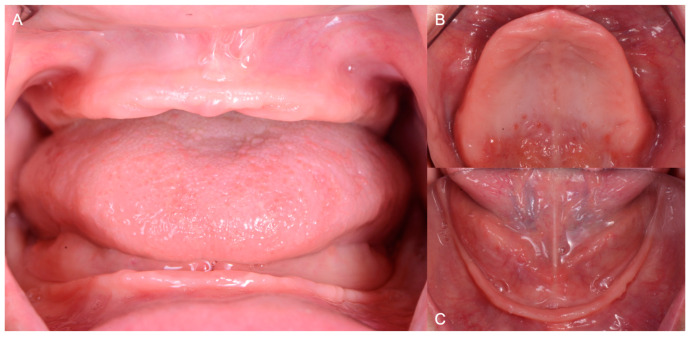
Fig. 2 — Intraoral status at initial consultation. Severe alveolar ridge resorption on both arches placed this case in the complex edentulous rehabilitation category.
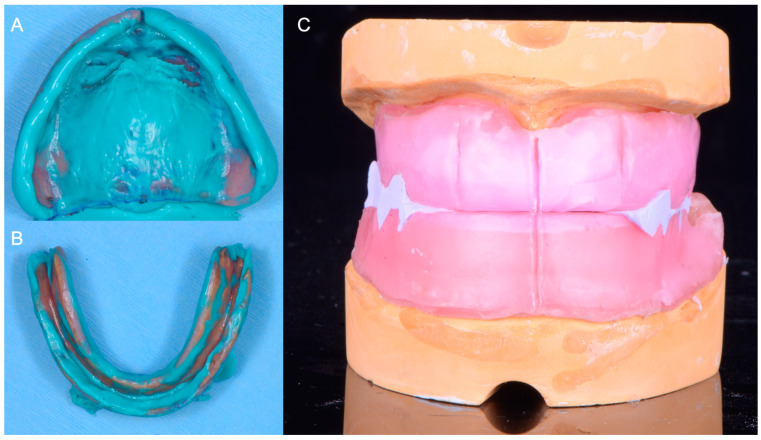
Fig. 3 — Final impressions and jaw relationship records. These records re-established the occlusal foundation required for all subsequent restorative steps.
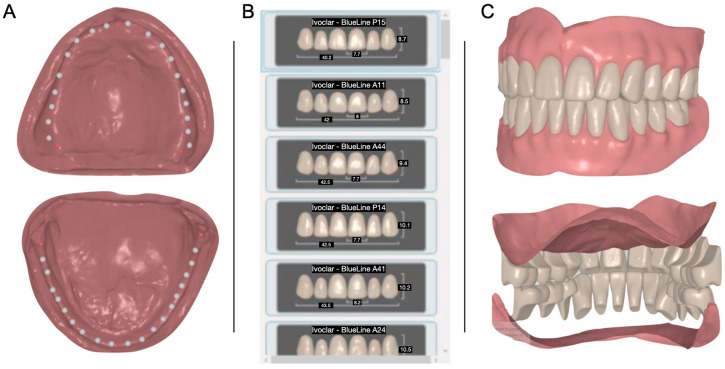
Fig. 4 — CAD/CAM digital design. Using the recorded vertical dimension and occlusal relationship as the reference, the tooth positions and prosthetic design were finalized digitally.
The New Dentures Were a Verified Starting Point, Not Just a New Prosthesis
Once the new complete denture set was fabricated, the treating physician didn't simply check the fit and move on. The evaluation covered:
Centric relation
Vertical dimension of occlusion
Lip support
Phonetics
Smile line
Patient comfort and acceptance
Each of these parameters was confirmed before the case moved forward. The value of this step wasn't in the technology used — it was in the fact that the most important variables were verified before implant surgery, not discovered to be off after the fixed restoration was already in place.
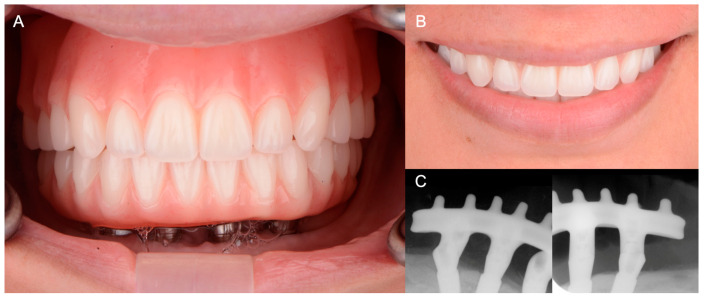
Fig. 5 — Try-in of the first CAD/CAM-fabricated complete denture set. The physician and patient jointly confirmed esthetics, lip support, phonetics, and vertical dimension before proceeding to implant placement.
Implant Placement Came After the Foundation Was Set
With the new dentures establishing a verified occlusal foundation, the treating physician proceeded to place four implants in the mandible, positioned between the mental foramina. This placement strategy — well-documented in the implant literature for edentulous lower arch rehabilitation — takes advantage of the typically denser bone in the anterior mandible and avoids the anatomical risks associated with posterior implant sites in severely resorbed ridges.44
The significance of this step extended beyond simply "fixing the lower denture in place." By prioritizing fixed implant support in the lower arch — the area with the greatest functional impact on chewing stability and retention — the treatment addressed the most consequential deficit in Emma's daily oral function.
After a four-month osseointegration period, the implants had integrated sufficiently to support the final restoration. The treating physician then completed the final maxillary complete removable denture and the mandibular fixed implant-supported full-arch prosthesis — both designed to match the occlusal parameters already verified during the initial denture phase.
This is why treatment sequence matters in cases like this. The final result is only as reliable as the foundation it was built on. Getting the sequence right — verify first, then fix — is what makes the final restoration predictable.1,51,5
What Changed at the End
At final delivery, the treating physician reviewed esthetics, function, smile line, lip support, and phonetics. Both the patient and physician were satisfied with the outcome.
For Emma, the change wasn't simply that she had newer prosthetics. She had regained a more stable occlusal relationship, more natural facial support, and a level of confidence in eating and speaking that had been declining for years.
The kind of progressive dissatisfaction she had experienced — dentures that worked less and less well despite being remade — isn't always solved by fabricating a new prosthesis. Sometimes the underlying issue is the cumulative effect of years of ridge resorption, vertical dimension loss, and occlusal drift. Addressing those foundational problems, rather than only replacing the prosthesis on top of them, is what this treatment was designed to do.
For patients who have worn complete dentures for many years and find themselves increasingly dissatisfied — with chewing, with appearance, with stability — this case illustrates that a systematic evaluation of the underlying conditions is often worth pursuing before deciding on a path forward. What looks like a prosthetics problem may, on closer examination, involve more fundamental changes that benefit from a different approach.
Medical References
The following published literature was used to support general medical context in this article. References do not constitute endorsement of any specific treatment outcome.
Jurado CA, Azpiazu-Flores FX, Fu C-C, et al. Expediting the rehabilitation of severely resorbed ridges using a combination of CAD-CAM and analog techniques: A case report. Medicina. 2024;60(2):260.
Pham NQ, Gonda T, Maeda Y, Ikebe K. Average rate of ridge resorption in denture treatment: A systematic review. J Prosthodont Res. 2021;65(4):429–437.
Taylor M, Masood M, Mnatzaganian G. Longevity of complete dentures: A systematic review and meta-analysis. J Prosthet Dent. 2021;125(4):611–619.
Buser D, Sennerby L, De Bruyn H. Modern implant dentistry based on osseointegration: 50 years of progress, current trends and open questions. Periodontol 2000. 2017;73(1):7–21.
Thu KM, Molinero-Mourelle P, Yeung AWK, et al. Which clinical and laboratory procedures should be used to fabricate digital complete dentures? A systematic review. J Prosthet Dent. 2024;132(5):922–938.
Srinivasan M, Kalberer N, Fankhauser N, et al. CAD-CAM complete removable dental prostheses: A double-blind, randomized, crossover clinical trial evaluating milled and 3D-printed dentures. J Dent. 2021;115:103842.
AlHelal A, AlRumaih HS, Kattadiyil MT, Baba NZ, Goodacre CJ. Comparison of retention between maxillary milled and conventional denture bases: A clinical study. J Prosthet Dent. 2017;117(2):233–238.
