
After 12 years of escalating medication, a cross-border expert review connected Robert with a Beijing MDT team — and opened a clinical pathway his local physicians hadn't discussed.
Robert had been managing Type 2 diabetes for over a decade. He took his medications faithfully, watched what he ate, and showed up to every appointment. But his HbA1c hadn't budged below 8.5% in years — and at each visit, his doctor's answer was the same: increase the insulin.
"Every visit ended the same way," Robert recalls. "'Your numbers are up — let's increase your insulin.' After 12 years, the insulin wasn't fixing the problem. It was just managing my decline. I was constantly fatigued, gaining weight from the high doses, and terrified of the neuropathy creeping into my feet. I needed to know how to stop insulin — not just how to take more of it."
What Robert found, through a cross-border second opinion, was a clinical perspective he hadn't encountered before: one that treated the structural causes of his diabetes, not just the blood sugar numbers.
Robert's Clinical Profile at the Time of Referral
| Parameter | Details |
|---|---|
| Patient | Robert (pseudonym), 54-year-old Logistics Manager, Ohio, USA |
| Diagnosis | Type 2 Diabetes Mellitus (T2DM), 12-year history; Class II Obesity (BMI 36) |
| Current Medications | 60 units long-acting insulin daily + rapid-acting mealtime insulin + SGLT2 inhibitors |
| Glycemic Control | HbA1c consistently 8.5%–8.9% despite strict medication adherence |
| Chief Concern | Progressive fatigue, insulin-related weight gain, early peripheral neuropathy symptoms |
Why Standard Management Wasn't Working
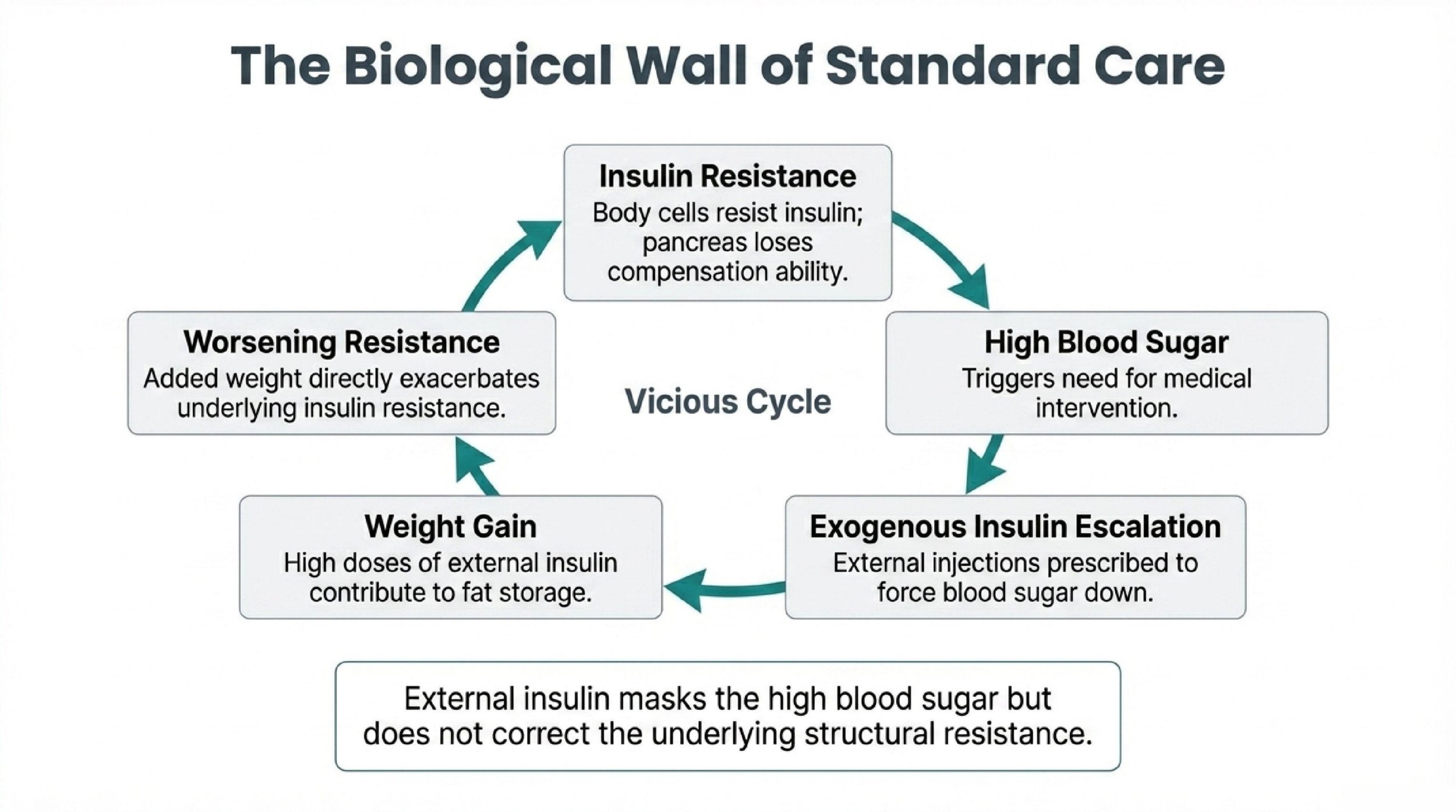
To understand why Robert's treatment had plateaued, it helps to look at the underlying biology. Type 2 diabetes involves two compounding problems: the body's cells become increasingly resistant to insulin, and the pancreas gradually loses its ability to compensate. External insulin injections address the resulting high blood sugar — but they don't correct the insulin resistance itself, and at high doses, they can contribute to further weight gain, which worsens the resistance.
For patients like Robert — with long-standing T2DM, significant obesity, and a BMI above 35 — research over the past two decades has increasingly supported a different approach: metabolic surgery. Procedures like Roux-en-Y Gastric Bypass (RYGB) work not just by reducing stomach size, but by altering the anatomy of the upper gastrointestinal tract in ways that directly affect gut hormone signaling. By bypassing the duodenum, the surgery triggers rapid increases in GLP-1 and PYY — hormones that improve insulin sensitivity and regulate blood sugar — often within days of the procedure, before significant weight loss has even occurred.
This is not a fringe approach. It is recognized in clinical guidelines from the American Diabetes Association and endorsed by major endocrinology societies for eligible patients. The challenge for Robert was that this option had never been presented to him.
A Second Opinion Through PandaMed's $299 Expert Review
Robert submitted his 12-year medical history through PandaMed's $299 Expert Review — a case coordination service that facilitates evaluation by senior specialist physicians at leading hospitals in Beijing. His records were reviewed by a multidisciplinary team (MDT) comprising a Chief of Endocrinology and a Chief of Metabolic Surgery, both affiliated with a top-ranked hospital in China.
The contrast in clinical perspective was immediate and significant.
The U.S. Endocrinologist's Approach (Conservative Medical Management)
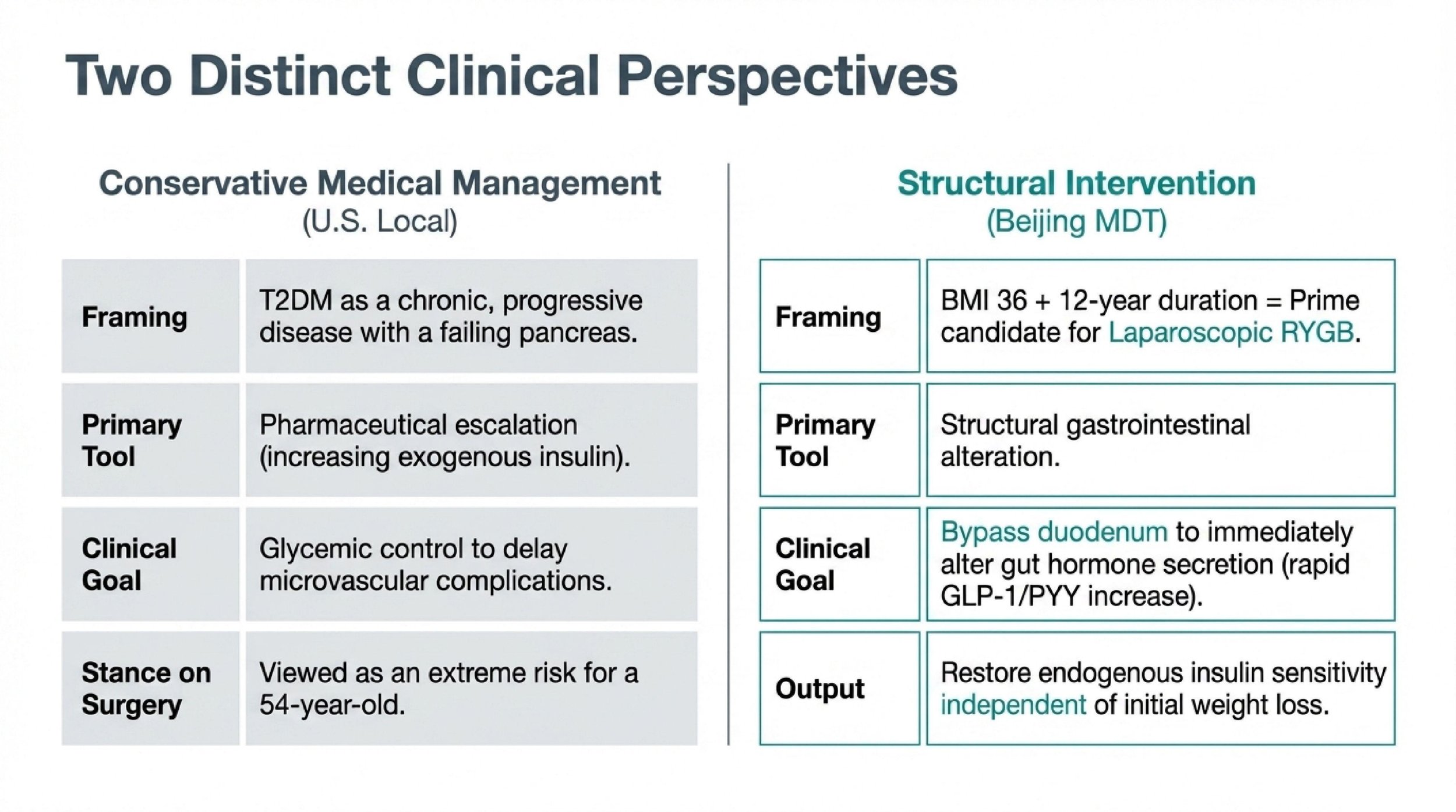
Robert's local physician had framed T2DM as a chronic, progressive disease with a failing pancreas. The clinical goal was glycemic control through pharmaceutical escalation — increasing insulin doses to delay microvascular complications. Surgical intervention was considered an extreme risk for a 54-year-old patient.
The Beijing Metabolic Surgeon's Assessment (Structural Intervention)
The Beijing metabolic surgeon reviewed Robert's profile — BMI 36, 12-year disease duration, Class II obesity — and identified him as a clinically suitable candidate for Laparoscopic Roux-en-Y Gastric Bypass (RYGB). The rationale: bypassing the duodenum would immediately alter gut hormone secretion, increasing endogenous GLP-1 and PYY, and could restore meaningful insulin sensitivity independent of weight loss alone.
The Beijing Endocrinologist's Position (Perioperative Metabolic Management)
The endocrinologist on the MDT emphasized that surgery alone would be insufficient for a patient with 12 years of T2DM and likely diminished pancreatic reserve. A structured perioperative metabolic management plan was essential: aggressive short-term glycemic optimization before surgery, followed by a carefully supervised, stepwise reduction of exogenous insulin post-operatively — to avoid hypoglycemic episodes as the body's own insulin sensitivity recovered.
MDT Consensus
The team's joint recommendation: neither surgery alone nor continued medical management alone was the optimal path. The most appropriate approach for Robert was a combined MDT intervention — metabolic surgery performed by a high-volume surgical team, with concurrent endocrinological management before and after the procedure.
Understanding the Trade-Offs: What the Beijing Team Disclosed
A meaningful part of Robert's evaluation involved an honest, structured discussion of both the potential benefits and the real risks of metabolic surgery. The Beijing MDT presented the following assessment:
| Consideration | Detail | Clinical Context |
|---|---|---|
| Insulin Reduction or Independence | Published data from high-volume centers suggest approximately 75% of T2DM patients with BMI >35 who undergo RYGB achieve significant reduction or complete discontinuation of insulin within 6 months. | Outcomes vary by disease duration, residual beta-cell function, and patient adherence. Individual results cannot be predicted in advance. |
| HbA1c Improvement | Sustained reduction to below 6.5% without oral hypoglycemics has been documented in eligible patients. | Not universal; depends on preoperative pancreatic reserve and postoperative lifestyle. |
| Cardiovascular Risk Reduction | Long-term reduction in myocardial infarction and stroke risk associated with uncontrolled T2DM. | Supported by long-term outcome studies in metabolic surgery literature. |
| Post-Prandial Hypoglycemia / Dumping Syndrome | Rapid gastric emptying can cause dizziness and blood sugar drops if high-sugar foods are consumed post-operatively. | Manageable with permanent dietary discipline; requires patient commitment. |
| Micronutrient Deficiency | The bypass mechanism requires lifelong daily supplementation: Vitamin B12, Iron, Calcium, and Vitamin D. | Non-negotiable; deficiencies will develop without consistent supplementation. |
| Surgical Complications | Risks of anastomotic leak or internal hernia are reported at <1.5% at high-volume centers performing over 500 cases per year. | Risk profile is meaningfully lower at specialized, high-volume surgical centers. |
The Clinical Timeline in Beijing: Six Days
Six weeks after his initial PandaMed consultation, Robert traveled to Beijing. His inpatient stay lasted six days. PandaMed coordinated his medical record translation, hospital admission scheduling, and on-the-ground communication support throughout.
Days 1–2 — Pre-operative Optimization: The endocrinology team used continuous glucose monitoring (CGM) and an insulin pump to bring Robert's blood glucose into an optimal pre-surgical range of 110–140 mg/dL. This step was clinically important: tighter glycemic control before surgery meaningfully reduces the risk of post-operative infection and supports healing.
Day 3 — Surgery: A laparoscopic Roux-en-Y Gastric Bypass was performed. Total operative time: 92 minutes.
Days 4–6 — Recovery Under ERAS Protocol: Robert was mobilized within six hours of surgery under an Enhanced Recovery After Surgery (ERAS) protocol. Within 48 hours, his care team observed measurable improvements in insulin sensitivity — attributed to the altered gut hormone environment — and his exogenous insulin dosage was reduced by approximately 70%. He was discharged on Day 6.
Six-Month Follow-Up: What the Data Showed
At his six-month telemedicine follow-up — conducted remotely with the Beijing team — Robert's results were documented as follows:
| Before | After (6 months) | |
|---|---|---|
| HbA1c | 8.8% | 6.2% |
| Insulin | 60 units/day + mealtime doses | Fully discontinued |
| SGLT2 Inhibitors | Active | Discontinued |
| Current Medications | Multiple diabetes drugs | Post-bariatric multivitamins only |
| Weight / BMI | BMI 36 | –45 lbs; BMI stabilized at 27 |
"My U.S. doctor told me my pancreas was dying and insulin was my permanent reality," Robert says. "Going to Beijing didn't just give me a smaller stomach. It gave me a completely different clinical picture. This wasn't just weight loss — it was a metabolic reset I didn't know was still possible."
Robert continues to follow up with both the Beijing team remotely and his local physician in Ohio, who now monitors his ongoing progress.
What PandaMed's $299 Expert Review Actually Covers
PandaMed is a cross-border medical coordination service. It is not a hospital or clinical provider. What the $299 Metabolic and Endocrine Expert Review provides is structured access to a dual-specialty evaluation by senior physicians — a Chief of Endocrinology and a Chief of Metabolic Surgery — at a top-ranked hospital in Beijing.
The review is designed to answer a specific question that many T2DM patients in Robert's position are asking: Is there a clinical pathway I haven't been offered yet?
The review includes a physician-led assessment of your case, a data-informed projection of whether metabolic surgery may be appropriate for your profile, a comparison of surgical modalities (Sleeve Gastrectomy vs. RYGB) based on your beta-cell function and disease history, and a clear summary of findings in English. PandaMed also coordinates the logistics of medical record translation, imaging review, and — for patients who proceed — hospital admission scheduling, visa guidance, and post-operative remote monitoring support.
All medical evaluations, diagnoses, and treatment recommendations are made by the licensed physicians and hospital teams in Beijing. PandaMed facilitates access and communication; it does not make clinical decisions.
Find Out If This Pathway Is Right for You
If you've been managing Type 2 diabetes for years with escalating medication and limited progress, it may be worth asking whether a specialist evaluation could offer a different perspective on your options.
PandaMed's $299 Expert Review connects you with a Beijing MDT team for a structured, English-language clinical assessment of your case — typically delivered within 72 hours of submitting your records.
To learn more or submit your case for review, reach out to the PandaMed team at:
contact@pandamedglobal.com
No commitment required. The review is an evaluation, not a treatment plan. All clinical decisions remain with you and your physicians.
Disclaimer
This article is intended for informational and educational purposes only. It describes the individual experience of one anonymized patient and does not represent a typical outcome or predict results for any other individual. Treatment suitability and outcomes vary significantly based on diagnosis, disease history, current health status, and physician evaluation.
PandaMed Global is a cross-border medical coordination and case facilitation service. PandaMed is not a hospital, clinic, or licensed medical provider. PandaMed does not diagnose medical conditions, prescribe treatments, or make clinical decisions of any kind. All medical evaluations, diagnoses, and treatment decisions described in this article were made by licensed physicians and accredited hospital teams in Beijing, China.
Nothing in this article constitutes medical advice. Readers are strongly encouraged to consult a qualified healthcare professional before making any decisions about their medical care.
