
Ozempic Alternative: A U.S. Patient’s Metabolic Surgery Experience in Beijing
After medication side effects, repeated weight regain, and years of diabetes treatment, one patient looked beyond the U.S. for a second opinion
Sarah, a 45-year-old HR director from Texas, had spent years trying to lose weight and improve her blood sugar. By the time she began exploring treatment outside the United States, her BMI was 42. She was living with type 2 diabetes and hypertension and taking four daily medications, including Metformin, Glipizide, Lisinopril, and a statin.
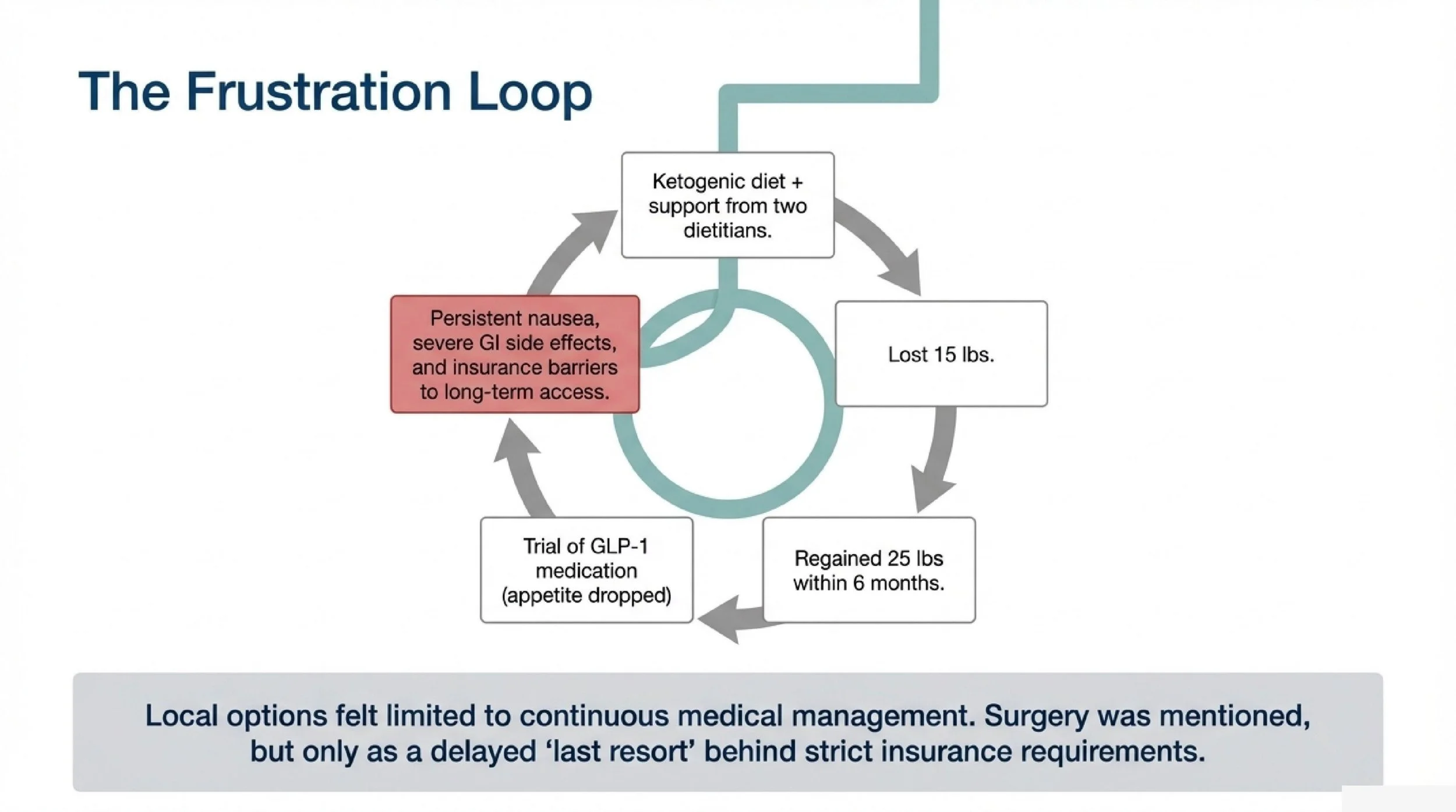
She had tried a ketogenic diet with support from two different dietitians. She initially lost about 15 pounds, but regained 25 pounds within six months. She then started a GLP-1 medication. Although her appetite dropped, the treatment became difficult to tolerate because of persistent nausea and other gastrointestinal side effects. She also became increasingly worried about the risks and limitations of staying on long-term medication, especially after facing insurance barriers to ongoing access.
For Sarah, this was the turning point. She was no longer looking for another short-term weight-loss plan. She wanted to understand whether there was a more durable treatment option for both obesity and diabetes.
When local options felt limited, she began looking for a metabolic surgery second opinion
Like many patients, Sarah did not immediately feel comfortable with the idea of surgery abroad. Her first reaction was simple: Would it really be safe to go to China for this?
What changed her mind was not a sales pitch. It was the structure of the evaluation.
Through PandaMed, she submitted her recent medical records, medication list, and lab results for review. PandaMed’s role was to help organize the case materials, support communication in English, and coordinate the second-opinion process with physicians in Beijing. The medical assessment itself was provided by the hospital team.
Within 72 hours, she received an English-language case review from a metabolic surgery team at a major tertiary hospital in Beijing. According to that review, the main issue was not simply appetite or willpower. The clinicians evaluated her case in the context of obesity, diabetes, medication history, and metabolic risk as a whole.
That distinction mattered to her. In her words, the process felt more like a serious medical evaluation than another weight-loss program.
Why Beijing became a realistic option
Sarah had already discussed treatment locally in the U.S., but the path felt slow and uncertain. Medical therapy had produced side effects without solving the larger problem. Surgery had been mentioned, but only as a later option, and insurance requirements created more delay.
The Beijing team approached the case differently. Rather than framing bariatric surgery as a last resort after endless cycles of failed dieting, they looked at whether she had a reasonable clinical indication for metabolic surgery now, given her BMI, type 2 diabetes, and medication burden.
They explained that, for some patients with obesity and poorly controlled metabolic disease, procedures such as laparoscopic sleeve gastrectomy may do more than reduce stomach volume. Depending on the patient’s condition, surgery may also improve blood sugar control, reduce insulin resistance, and support meaningful reductions in medication use over time. They were also clear that suitability depends on physician assessment, and that outcomes vary from person to person.
That balance of realism and clarity helped Sarah move from fear to decision-making.
A closer look at her pre-treatment situation
| Category | Details |
|---|---|
| Patient profile | Sarah (pseudonym), 45-year-old HR director from Texas |
| Main conditions | Severe obesity (BMI 42), type 2 diabetes, hypertension |
| Medication burden | Metformin, Glipizide, Lisinopril, and a statin |
| Previous weight-loss efforts | Keto diet with support from two dietitians; initial weight loss followed by regain |
| Medication experience | Trial of GLP-1 medication with significant nausea and GI side effects; ongoing concern about long-term tolerability and access |
| Main question | Whether metabolic surgery could offer a more durable treatment path than another medication cycle |
Comparing the treatment paths she was considering
Sarah was not choosing between “easy” and “hard.” She was choosing between several imperfect paths: trying another injectable medication, staying on her current course, or pursuing surgery.
The U.S. pathway she had encountered focused more heavily on continued medical management first. The Beijing review focused on whether surgery was already clinically appropriate based on the full picture.
| Parameter | Local U.S. Recommendation | Beijing Team Assessment (via PandaMed coordination) |
|---|---|---|
| Clinical approach | Primary focus remained medical weight management, including possible alternative injectables such as Wegovy or Zepbound. | Her case was reviewed as severe obesity with type 2 diabetes and cardiometabolic risk, and the team considered metabolic surgery a reasonable option for further evaluation. |
| Proposed solution | Bariatric surgery had been discussed, but only later in the treatment pathway. | The proposed pathway was laparoscopic sleeve gastrectomy after in-person testing and final physician clearance, with recovery guided by ERAS-based perioperative care. |
| System barriers | Insurance-related requirements and documentation of prior failed medical weight-loss attempts created additional delay. | The Beijing pathway did not depend on U.S. payer authorization, allowing direct specialist review once her records were submitted. |
| Mechanism focus | The explanation she had previously heard emphasized stomach restriction and weight reduction. | The Beijing team also discussed the metabolic effects of sleeve gastrectomy, including changes in appetite signaling and potential benefits for glycemic control in appropriately selected patients. |
The risks were discussed plainly
One reason Sarah felt more comfortable moving forward was that the consultation did not present surgery as a guaranteed answer.
The Beijing team discussed the expected benefits and the possible downsides. They reviewed the potential for meaningful weight loss and improved glycemic control, but also explained the need for long-term follow-up, careful nutritional monitoring, and vitamin supplementation after surgery. They also covered recognized surgical risks, including bleeding, leakage, reflux symptoms, and the fact that not every patient achieves the same degree of weight loss or diabetes improvement.
That kind of discussion helped build trust. She did not feel rushed. She felt informed.
Her trip to Beijing and the surgery itself
After deciding to proceed, Sarah traveled to Beijing for further evaluation and treatment. PandaMed helped with non-clinical coordination, including medical record collection, translation support, communication assistance, and travel-related guidance. The hospital handled all medical testing, admission decisions, surgical planning, and treatment.
Following in-person assessment, she underwent laparoscopic sleeve gastrectomy under general anesthesia.
Her early recovery was smooth. She was encouraged to start mobilizing soon after surgery and began a staged postoperative diet under the care instructions provided by the hospital team. She was discharged a few days later after her condition remained stable and no immediate complications were reported.
What changed over the next six months
Over the following months, Sarah remained in follow-up with her physicians.
By her six-month mark, her BMI had decreased from 42 to 31. Her blood sugar had improved enough that her doctors adjusted and then discontinued some of her diabetes medications. Her blood pressure treatment was also reduced later in the recovery period, based on her progress and physician review.
Just as important to her, she was no longer cycling through the same pattern of intense restriction, short-term loss, rebound gain, and medication side effects. She described the biggest change not as “finally getting thin,” but as feeling that her health had become more manageable again.
That said, her case is only one patient experience. Metabolic surgery is not appropriate for everyone, and postoperative progress depends on many factors, including diagnosis, baseline metabolic status, procedure type, follow-up adherence, and individual response.
What this case may mean for other international patients
For readers searching for an Ozempic alternative, Sarah’s experience illustrates an important point: sometimes the real question is not which medication to try next, but whether a broader treatment review is needed.
For some patients with obesity and type 2 diabetes, a structured review by a metabolic surgery team may clarify options that were not fully explored locally. That does not mean surgery is always the right answer. It means a proper evaluation can help distinguish between short-term symptom management and a longer-term treatment strategy.
For international patients considering care in Beijing, the process usually begins with records, lab work, imaging when available, and a physician-led review of whether treatment abroad is medically appropriate.
If you would like your case reviewed
If you are dealing with weight regain, medication side effects, or poorly controlled type 2 diabetes and would like help understanding whether a Beijing-based metabolic surgery evaluation may be appropriate, PandaMed can assist with case coordination, document preparation, translation, and communication support with hospitals and physicians.
For a low-pressure discussion or to begin a case review, you can email contact@pandamedglobal.com.
End Disclaimer
This article is for informational and educational purposes only. It reflects one anonymized real patient case and does not predict outcomes for other individuals. Treatment suitability and results vary based on diagnosis, disease status, prior treatment history, and physician evaluation. PandaMed is not a hospital, clinic, or medical provider. PandaMed does not diagnose, treat, or make medical decisions. All medical evaluation, diagnosis, and treatment are provided by licensed physicians and hospitals. Readers should consult a qualified healthcare professional before making medical decisions.
