
Second Opinion for Hypereosinophilic Syndrome: A Patient Case Study
How a remote hematology review in China helped one patient seek clearer guidance on a rare blood disorder
When a patient is living with a rare blood disorder, uncertainty can be just as difficult as the diagnosis itself. Even with local medical support, many patients and families still want a second opinion to better understand the diagnosis, confirm the treatment direction, and make decisions with greater confidence.
This case study follows one patient with Hypereosinophilic Syndrome (HES) who sought an expert hematology review in China through a fully remote, document-based consultation. Personal details have been anonymized to protect privacy.
This case reflects one patient’s individual experience. Treatment suitability and outcomes vary based on diagnosis, disease status, prior treatment history, and physician evaluation.
The Patient’s Situation
The patient came to PandaMed with a complex medical history involving idiopathic Hypereosinophilic Syndrome, a rare blood disorder in which the underlying cause had not yet been clearly identified. The case had already involved multiple bone marrow biopsies, reflecting both the seriousness of the diagnostic workup and the difficulty of reaching greater certainty.
Although the patient was already receiving local medical care, both the patient and family hoped to obtain a further specialist review. Their goal was not to replace their existing doctors, but to gain an additional expert perspective on the diagnosis and whether the current treatment direction remained appropriate.
For patients facing rare or difficult-to-interpret hematologic conditions, that kind of specialist confirmation can be an important part of decision-making.
Why the Patient Looked Beyond Local Care
Rare blood disorders such as HES can raise complex questions about diagnosis, disease classification, monitoring, and treatment planning. In this case, the patient and family felt they would benefit from a specialist opinion from a physician with strong experience in hematology.
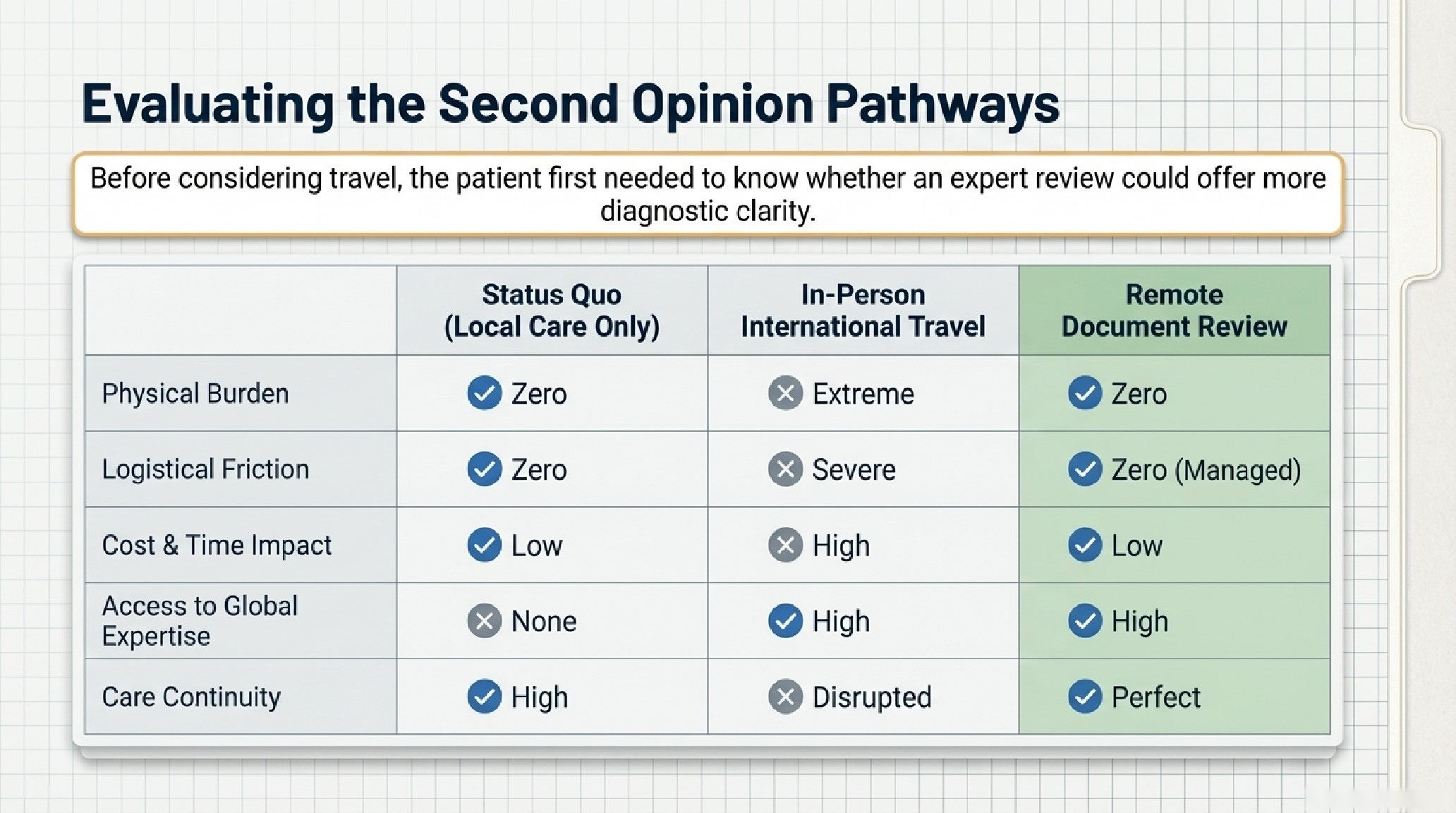
Traveling internationally for an in-person visit, however, would have meant added cost, time, and physical burden at an already stressful moment. There were also practical barriers, including medical record preparation, translation, and the challenge of communicating a complex case across healthcare systems.
As a result, a remote second opinion became the most realistic and proportionate next step.
Why a Remote Document-Based Consultation Made Sense
For a condition like HES, a carefully prepared document review can be highly useful in the early stage of cross-border evaluation. Before considering travel, the patient first needed to know whether an expert review could offer more diagnostic clarity or help confirm the next steps.
A remote consultation allowed the specialist to review the patient’s existing history and test results in a structured way, without requiring immediate international travel. It also made it possible for the patient and family to seek an additional perspective while continuing care locally.
This approach can be especially valuable for international patients who want more medical clarity before making larger decisions.
How PandaMed Supported the Case
PandaMed served as the cross-border case coordination team, not the medical provider. The specialist opinion came from Dr. Kai Xue, Hematologist at Shanghai Ruijin Hospital, while PandaMed supported the non-clinical parts of the process.
Our team helped collect and organize the patient’s existing records, including prior biopsy findings and relevant medical history. We then translated and prepared the materials so they could be reviewed more clearly by the receiving specialist.
PandaMed also coordinated the remote, document-based consultation process, helping ensure that the case materials were submitted in an organized format and that communication moved forward efficiently.
Because the consultation was conducted remotely, the patient was able to remain at home while the case underwent expert review in China.
The Result
Following the review, the patient received a written PDF report from Dr. Xue.
The value of the report was not in making dramatic promises, but in offering a more structured specialist assessment of the existing diagnosis and helping clarify the appropriate next steps for treatment discussion. For the patient and family, this added a level of expert review that was difficult to access locally and would have been burdensome to pursue through travel alone.
Just as importantly, the patient could bring that specialist input back into discussions with their local physicians. In this way, the remote consultation supported continuity of care rather than replacing it.
Why This Case Matters for Other International Patients
This case may resonate with patients and families dealing with a rare blood disorder, an uncertain hematology diagnosis, or a treatment plan they want reviewed more carefully.
In situations like these, patients are often not looking for marketing language or quick reassurance. They are looking for a practical way to answer questions such as:
Is my current diagnosis being interpreted correctly?
Would an additional specialist review be helpful?
Can I seek expert input without traveling right away?
How do I prepare my records for an international consultation?
This case shows that, in some situations, a remote second opinion can provide a useful next step before more complex decisions are made.
Need Help Exploring a Hematology Second Opinion?
If you or a family member is facing a rare blood disorder and would like to explore whether a remote second opinion may be appropriate, PandaMed may be able to help with case preparation, medical record translation, and cross-border consultation coordination.
To discuss your situation, you are welcome to contact us at contact@pandamedglobal.com.
