
Essential Apps for Medical Travel to China: What Patients Should Download
A practical guide to the communication, payment, translation, navigation, and document tools international patients may need before treatment in China.
If you are traveling to China for medical care, your phone is not just a travel accessory. It is part of your care logistics.
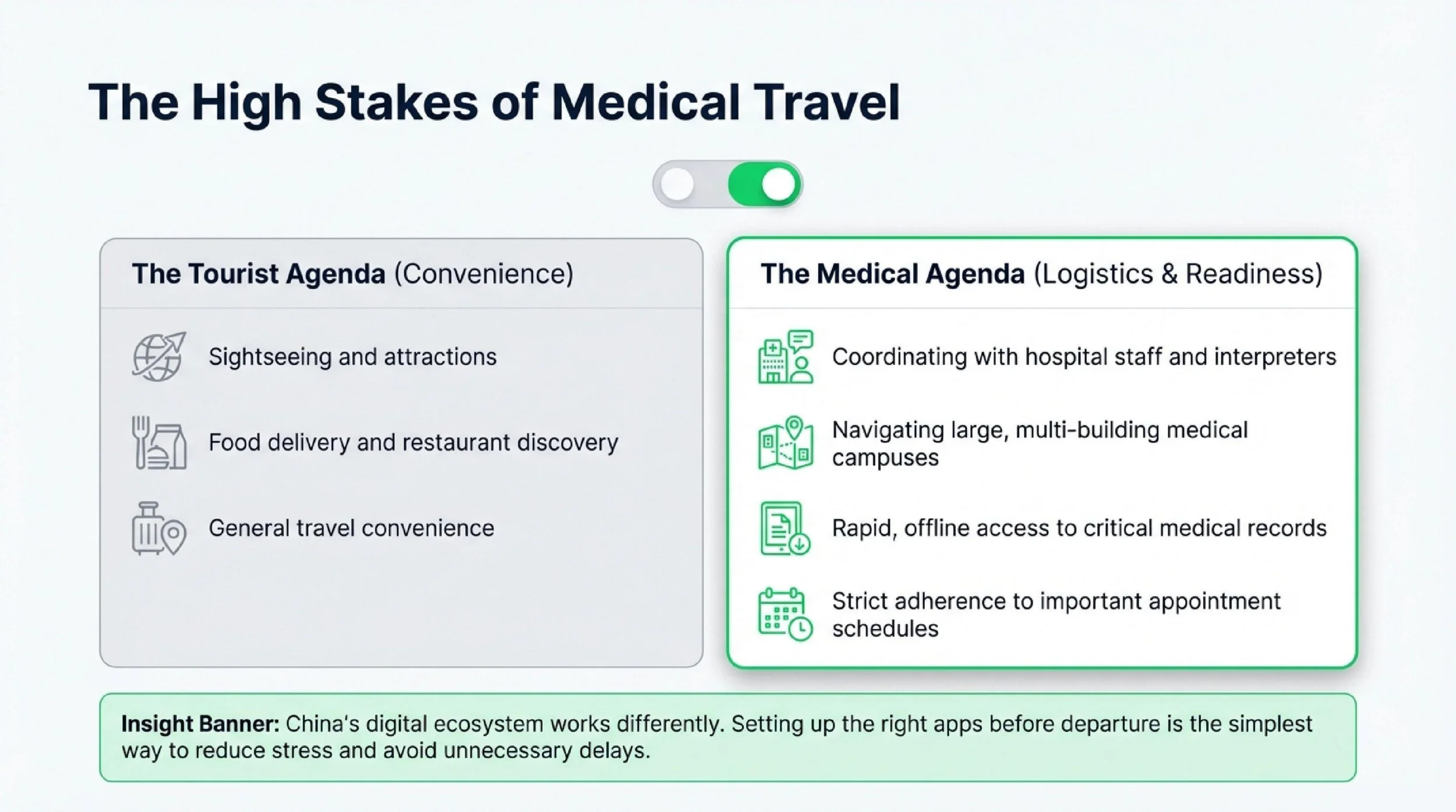
Most online lists of “must-have apps for China” are written for tourists. They focus on sightseeing, food delivery, and travel convenience. But if you are coming for treatment, your priorities are different. You may need to communicate with hospital staff, navigate a large medical campus, pay for pharmacy items, access medical records quickly, and stay on schedule for important appointments.
Because China’s digital ecosystem works differently from what many international patients are used to, setting up the right apps before departure is one of the simplest ways to reduce stress and avoid unnecessary delays.
Below is a practical list of the apps and digital tools that may matter most during a medical trip to China.
1. Communication: WeChat
If you download only one app before traveling to China, make it WeChat.
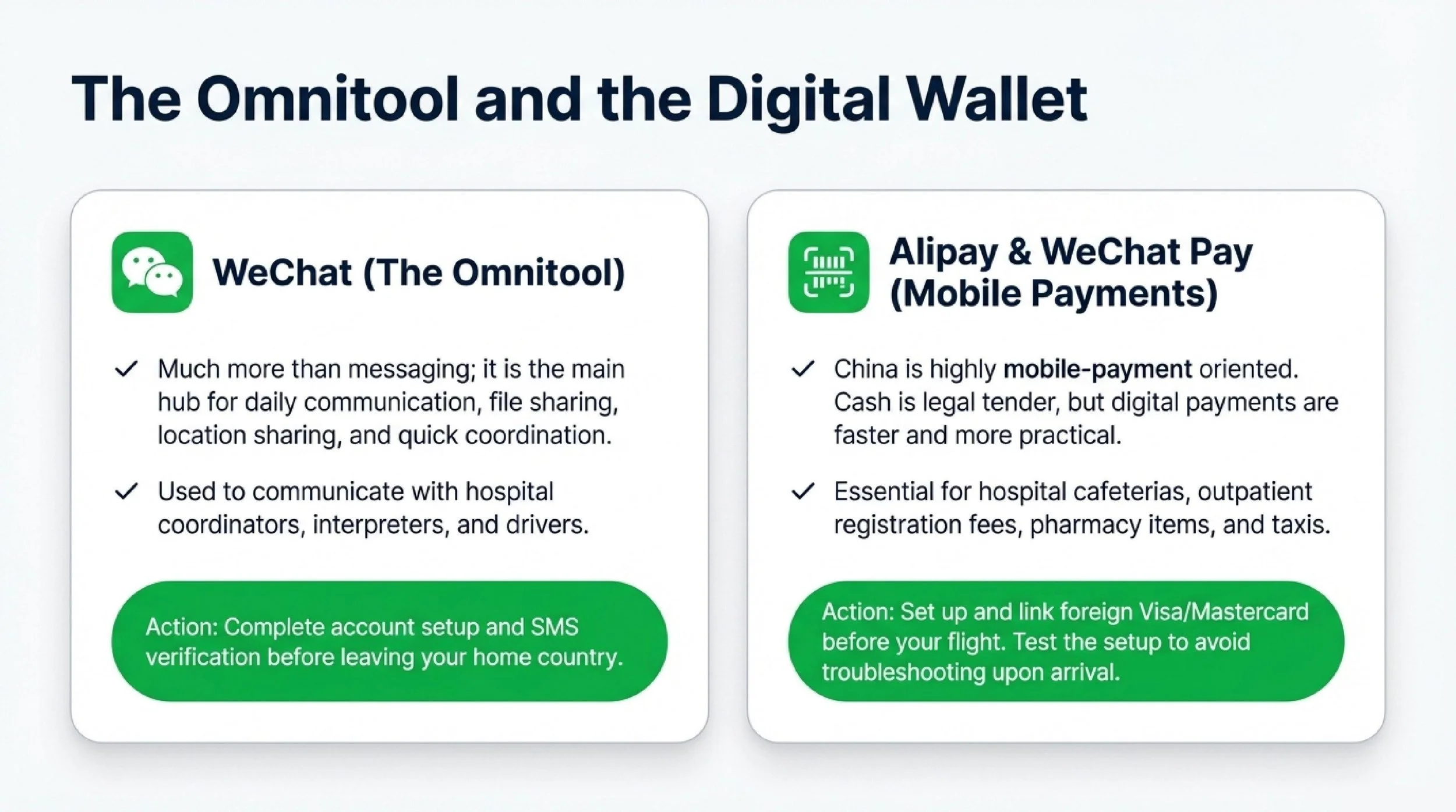
In China, WeChat is much more than a messaging app. It is often the main tool people use for daily communication, file sharing, location sharing, service updates, and quick coordination. For international patients, it can become one of the most important tools on the trip.
Why it matters for patients
You may use WeChat to communicate with hospital coordinators, interpreters, drivers, hotel staff, or other local contacts. In some cases, hospital-related communication may also happen through WeChat rather than email.
The app also includes translation functions for messages, which can be helpful for simple exchanges when language support is not immediately available.
What to do before you travel
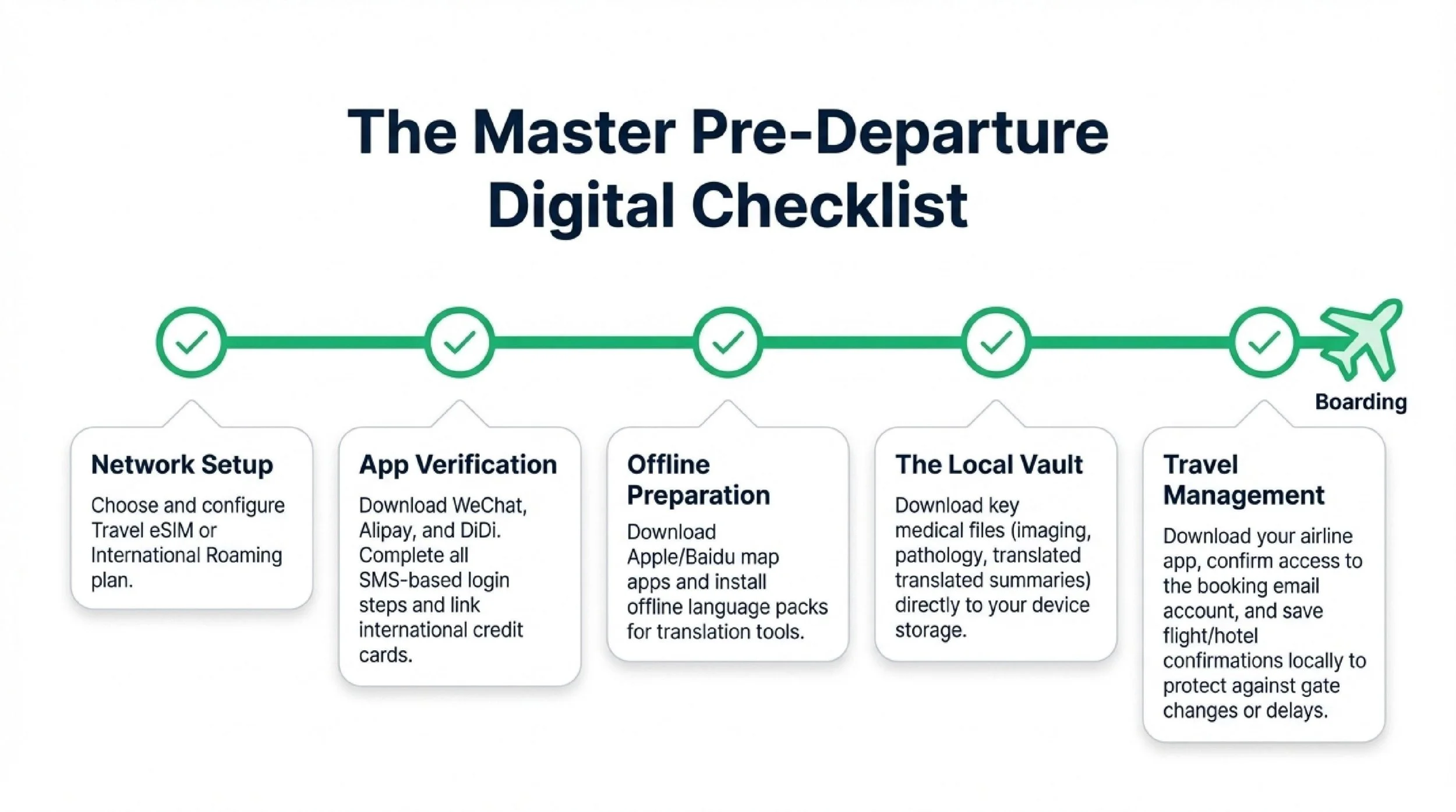
Download WeChat and complete account setup before leaving your home country. Account verification and SMS-based login steps may be easier to handle before international travel begins.
2. Payments: Alipay and WeChat Pay
China is now highly mobile-payment oriented. Even if you plan to use a bank wire transfer or an international credit card for major hospital costs, you may still need mobile payments for smaller but frequent expenses.
Why it matters for patients
Patients often use mobile payment for hospital cafeteria meals, taxis, convenience-store purchases, outpatient registration fees, and pharmacy payments. In many everyday situations, mobile payment is faster and more practical than cash.
What to do before you travel
Set up Alipay and, if relevant for your situation, WeChat Pay before your flight. International visitors can often link foreign Visa or Mastercard cards, but verification requirements and transaction limits may vary by card issuer, app rules, and usage scenario.
It is wise to test the setup before departure rather than trying to troubleshoot it after arrival.
3. Translation: Apple Translate, Baidu Translate, or Another Offline-Capable Tool
Even with an interpreter or coordinator involved, there will still be moments when you need immediate language support. A nurse may give a quick instruction. A staff member may point you to another department. A driver may need to confirm the correct hospital entrance.
Why it matters for patients
Medical travel includes many short, practical conversations that do not always happen in a formal consultation room. A translation app can help with basic directions, check-in steps, and simple follow-up questions.
It should not be used as a substitute for professional medical interpretation when discussing diagnosis or treatment decisions. But for day-to-day logistics, it can be extremely helpful.
What to do before you travel
Choose a translation app that supports offline language packs. Apple Translate works well for many iPhone users, and Baidu Translate may be useful in local settings. Download the relevant language packs before departure so the app remains useful if your signal is weak inside a hospital building.
4. Maps and Navigation: Apple Maps or Baidu Maps
Getting to the right hospital is only part of the challenge. In many cases, you also need to find the right building, entrance, registration area, or department inside a very large campus.
Why it matters for patients
Major public hospitals in China can be large and busy, sometimes spanning multiple buildings or separate entrances. Arriving at the wrong gate can create unnecessary stress, especially when you are trying to reach an appointment on time.
What to do before you travel
If you use an iPhone, Apple Maps is often the easiest option because it uses local map data. If you use Android, Baidu Maps is commonly the more reliable local choice.
It is a good idea to save key places in advance, such as your hospital, hotel, pharmacy, and airport.
5. Ride-Hailing: DiDi
When you are traveling for medical care, reliable transportation matters. Even short trips can feel stressful when you are dealing with fatigue, pain, mobility limits, or a tightly scheduled appointment day.
Why it matters for patients
DiDi is widely used in China and can make travel between the hotel, hospital, airport, and pharmacy much easier. It may also reduce the stress of explaining destinations in person to a taxi driver if you do not speak Chinese.
What to do before you travel
Download DiDi before arrival and check whether your preferred payment method can be linked in advance. Some international travelers also access DiDi through integrated mini-programs, but having the main app ready may be simpler.
6. Medical Documents and Local File Storage
This may be the most overlooked part of digital preparation.
Many patients keep their medical records in cloud storage services they use at home. But depending on your network setup in China, those services may not always be the fastest or most reliable way to access a file in real time.
Why it matters for patients
If a physician asks to see a pathology report, imaging summary, medication list, or translated case summary, you need to be able to pull it up immediately. Delays caused by poor connectivity or forgotten passwords can create avoidable friction.
What to do before you travel
Save key documents directly to your phone or tablet, not only in the cloud. Useful files may include:
passport copy
visa copy
translated medical summary
pathology reports
imaging reports
medication list
recent lab results
hospital appointment confirmations
If possible, keep both a local digital folder and a printed backup of the most important items.
7. Flight and Travel Management: Your Airline App and Email Access
Medical travel is often tightly scheduled. A delayed flight, gate change, or baggage issue can affect your first consultation or check-in window.
Why it matters for patients
Patients are not just traveling for leisure. They may have consultations, imaging appointments, admission dates, or care coordination arranged soon after arrival. Keeping flight updates easy to access helps reduce last-minute confusion.
What to do before you travel
Download your airline’s app and make sure you can access the email account used for bookings. Save flight confirmations, hotel confirmations, and transport details locally on your phone as well.
8. Connectivity Setup: eSIM, Roaming, and Network Planning
The usefulness of all your apps depends on one thing: whether your phone stays connected.
Why it matters for patients
Without stable mobile data, even the best-prepared phone setup becomes less useful. Messaging, map access, payment apps, and ride-hailing all depend on reliable connectivity.
What to do before you travel
Many international patients choose either international roaming through their home carrier or a travel eSIM before departure. Roaming may allow easier access to the services you normally use, but cost and performance vary. A travel eSIM may be more affordable, but setup should be completed before travel.
Your best option depends on your phone, carrier, budget, and communication needs.
A Note on Hospital Booking Apps and Mini-Programs
Many major Chinese hospitals have their own booking systems, often inside WeChat or Alipay mini-programs, or through standalone hospital apps.
For international patients, however, these tools may not always be easy to use independently. Some are mostly in Chinese. Some may require local verification steps. Some may work differently depending on department or patient identity.
That is why these booking tools are worth understanding, but not always realistic to rely on without guidance.
When Apps Are Not Enough
The right apps can make your trip much smoother. But digital tools cannot replace human coordination when the process becomes more complex.
Even with the right apps, international patients may still find appointments, translation, hospital communication, and day-to-day logistics difficult to manage alone. A translation app cannot tell you which department is best suited for your case. A payment app cannot explain a hospital billing question. A map app cannot help if your records are incomplete or your appointment process changes at the last minute.
PandaMed supports international patients traveling to Beijing by helping them prepare before arrival and navigate practical issues during their stay. This may include case preparation, medical record organization, communication support, and guidance on common setup questions related to tools such as messaging or payment apps.
For patients who want a smoother start, this kind of support can reduce the amount of trial and error that often happens when trying to manage a complex medical trip alone. Patients traveling with PandaMed support may also have access to a dedicated support contact during their time in China.
If you would like help preparing for medical travel to Beijing, you are welcome to contact PandaMed at contact@pandamedglobal.com.
Frequently Asked Questions
Will my phone internet work in China?
In many cases, yes, but it depends on how you connect. International roaming through your home carrier may allow you to continue using your usual apps and services, though costs can be high. Many travelers prefer to set up a travel eSIM before departure.
Do I need a VPN?
That depends on which services you rely on and how you plan to connect. Some international services may not function reliably on local networks in China. If you expect to need certain email, messaging, or cloud platforms during your trip, it is wise to research your options before departure and complete any necessary setup in advance.
Can I just use cash for everything?
Cash is still legal tender in China, but in day-to-day practice, many patients find mobile payment much more convenient. Some taxis, kiosks, and smaller service points may be easier to manage with Alipay or WeChat Pay already set up.
Is there an app to book hospital appointments?
Many hospitals do have their own apps or mini-programs for booking. However, these tools are often designed for local users and may be difficult for international patients to navigate without language support or prior setup guidance.
If you are preparing for treatment in Beijing and want help organizing the practical side of the trip, PandaMed can support you before arrival and during your stay. For general inquiries, contact contact@pandamedglobal.com.
