
Can Family Members Accompany Patients to China for Treatment?
For many international patients, medical travel is not a solo decision. A spouse, parent, adult child, or other close family member is often the one helping with research, records, budgeting, and daily planning.
So one of the most common questions families ask is simple: Can a family member travel with the patient to China for treatment?
In many cases, yes. But the more important answer is this: what that companion experience looks like can vary significantly depending on the hospital type, the patient’s condition, and the stage of treatment.
That distinction matters. In China, major public hospitals are primarily built to serve the domestic population at very high volume. International patients can still access care, but inpatient routines, ward design, and family accommodation are usually not structured around long, comfortable companion stays. By contrast, some private hospitals and international wards may offer a more spacious and flexible environment for accompanying family members.
If your family is considering treatment in China, it is important to understand that “bringing a companion” is possible in many situations, but the practical conditions may look very different from one hospital setting to another.
Public Hospitals vs Private Hospitals: What Families Should Realistically Expect
This is often the most important issue for families planning a medical trip.
Public Hospitals: Strong Clinical Resources, More Limited Companion Conditions
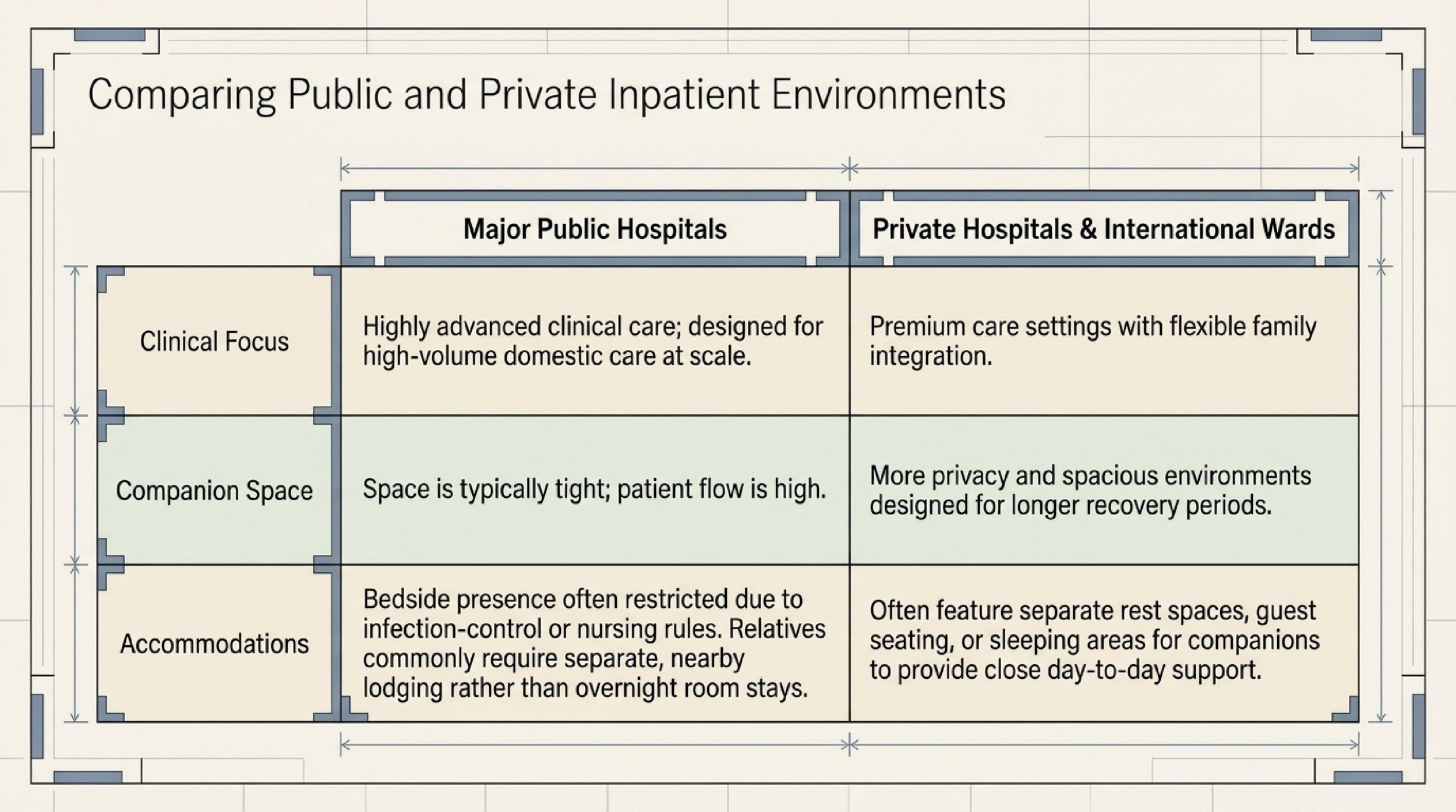
Many of China’s leading public hospitals offer highly advanced clinical care, especially for complex surgery, oncology, neurology, and other specialist fields. However, these hospitals are first and foremost large domestic care systems serving Chinese patients at scale.
That means companion conditions are often more limited than some international families expect. In standard inpatient wards, space is usually tight, patient flow is high, and ward management rules may restrict how long family members can remain at the bedside. In some departments, long stays by accompanying relatives may not be practical, and in others they may be limited for administrative, infection-control, or nursing management reasons.
Even when a family member can accompany the patient through parts of the process, the setting may not be designed for comfort. It is common for relatives to need separate nearby accommodation rather than staying in the patient’s room overnight.
Private Hospitals and International Wards: Usually More Comfortable for Family Support
Some private hospitals, as well as certain international or VIP wards, may offer a more comfortable companion experience. Compared with standard public hospital wards, these settings may provide more privacy, more flexible family presence, and better support for day-to-day recovery needs.
Depending on the hospital and room type, families may find separate rest space, a guest seating or sleeping area, or a more private environment for accompanying the patient. In some settings, this can make a major difference for families who expect a longer recovery period, need closer day-to-day support, or simply want a less stressful inpatient experience.
However, these arrangements are not identical across all hospitals. Companion conditions still depend on room availability, department policy, treatment type, and the hospital’s own rules.
Meals and Daily Living: Another Major Difference Between Hospital Types
Food arrangements are another area where families should avoid assumptions.
In most public hospitals, the hospital generally does not arrange dedicated meals for accompanying family members. Patients may receive meals through hospital systems or patient-focused meal channels, but companions usually need to handle their own food separately.
In some private hospitals or higher-comfort international settings, meal arrangements may be more flexible. Depending on the hospital, there may be options for customized meals, companion meal arrangements, or a setup that allows family members to prepare or share meals more comfortably.
These details can matter a lot during recovery, especially for elderly patients, post-operative cases, or families staying for an extended period.
What a Family Companion Actually Helps With
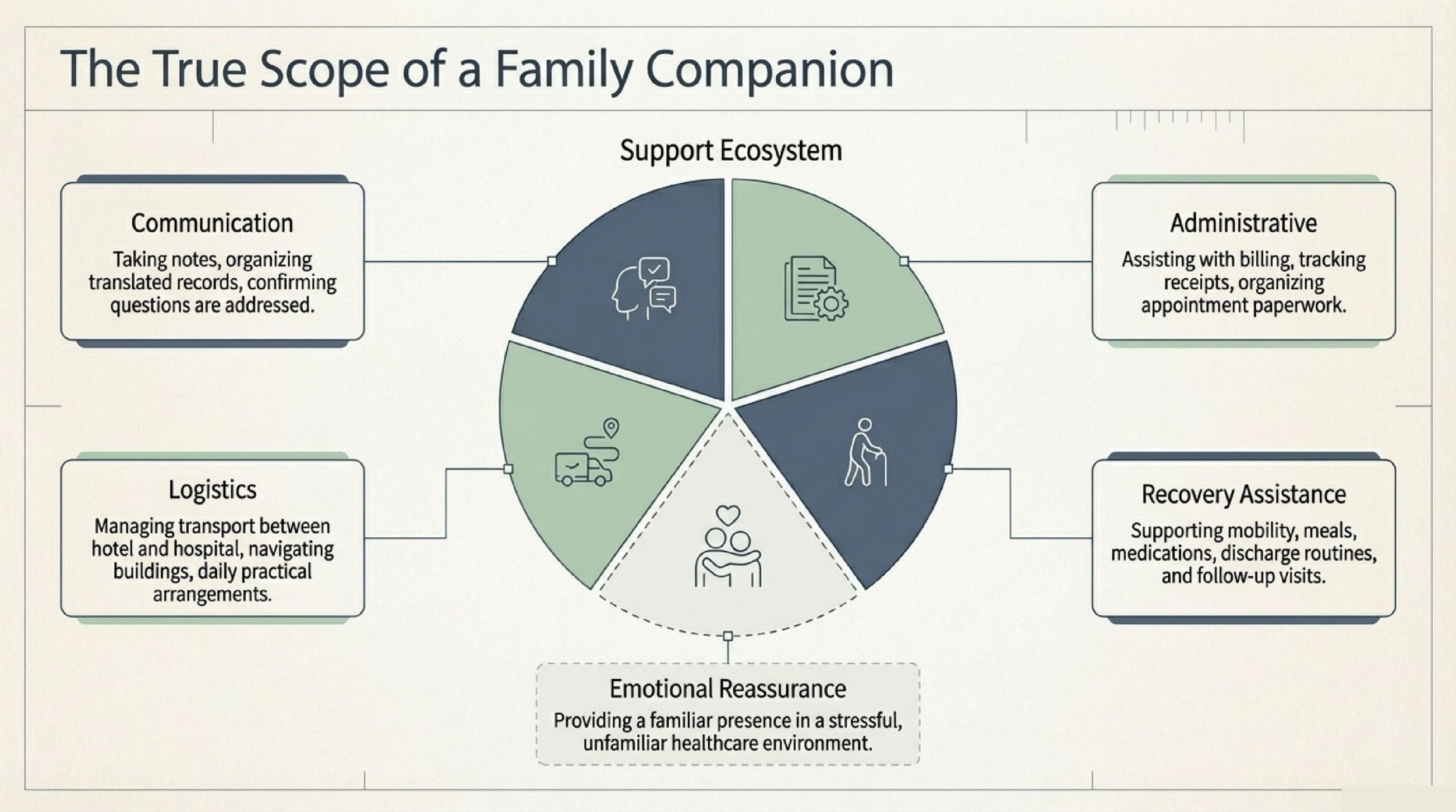
| Responsibility Area | What the Companion May Help With in China |
|---|---|
| Communication and support | Taking notes during consultations, helping organize translated records, and making sure the patient’s main questions and concerns are clearly addressed. |
| Hospital and daily logistics | Helping the patient move between the hotel and hospital, handling transport, navigating hospital buildings, and managing practical day-to-day arrangements. |
| Administrative tasks | Assisting with billing steps, tracking receipts, organizing appointment paperwork, and helping the patient keep important hospital documents in order. |
| Recovery assistance | Supporting the patient after surgery or treatment with mobility, meals, medications, discharge routines, and follow-up visits. |
| Emotional reassurance | Providing a familiar presence during a stressful and unfamiliar medical trip, especially when the patient is tired, anxious, or recovering. |
Families often think of a companion mainly as emotional support. In reality, the role is much broader.
A family member may help keep track of appointments, organize records, take notes during consultations, and make sure important questions are clearly addressed. They may also handle practical tasks such as local transportation, hotel coordination, payments, discharge logistics, medication pickup, and communication follow-up after consultations or procedures.
After surgery or during a physically demanding treatment course, the companion may also become the patient’s main day-to-day support person outside the hospital room. That can include helping with mobility, meals, medication routines, and post-discharge observation.
Emotional support matters too. Even medically stable patients often feel more secure when a trusted family member is nearby, especially in an unfamiliar healthcare environment.
When a Companion Is Especially Worth Considering
Not every patient must travel with a family member. But for some cases, it is strongly worth considering.
A companion is often especially helpful for major surgery, chemotherapy, complex multidisciplinary care, elderly patients, and children or dependent adults. In these situations, treatment itself may be only one part of the challenge. The patient may also need help with physical recovery, decision-making, communication, or daily management outside the hospital.
For relatively simple outpatient consultations or minor procedures, some patients may be able to travel alone. But even then, that depends on the patient’s functional status, anxiety level, language comfort, and how complicated the logistics are likely to be.
If the Patient Travels Alone
Some international patients do choose to travel to China alone, especially for a consultation, second opinion, targeted diagnostics, or a limited procedure.
If that is the plan, preparation matters even more. The patient should make sure key medical records are organized in advance, emergency contacts are documented clearly, and all important instructions can be reviewed later in writing. It is also wise to think carefully about what kind of support will be available on the ground if the patient becomes tired, uncomfortable, or confused by logistics after arrival.
For solo travelers, the biggest challenge is often not the medical appointment itself, but everything around it: transportation, payment, follow-up timing, medication pickup, discharge planning, and communication.
Planning Companion Support Early Can Reduce Stress Later
Families are often less worried about whether a companion is legally allowed to travel, and more worried about whether the arrangement will actually work in real life.
That is why it helps to clarify early: how much support the patient is likely to need,
- whether a public hospital or a more comfort-oriented setting makes more sense,
- what companion access may look like in that hospital,
- where the family member will stay,
- how meals will be handled,
- and what the likely overall non-medical costs may be.
These questions are highly case-specific. They depend on diagnosis, treatment intensity, hospital type, city, room arrangement, and the family’s own expectations for comfort and support.
How PandaMed Can Help Families Plan More Realistically
PandaMed is not a hospital or medical provider. Our role is to help international patients and families better understand the practical pathway before travel.
Depending on the case, that may include helping families organize records, clarify the likely treatment pathway, understand differences between hospital settings, and think through practical issues such as companion feasibility, accommodation expectations, and travel-related planning.
If you are unsure whether a patient should travel with a companion, what companion conditions may be like at different hospitals, or how food, lodging, and support costs may vary, you are welcome to contact PandaMed at contact@pandamedglobal.com.
Some patients do travel alone. But many families feel more confident when planning, communication, and logistics are considered together from the beginning.
FAQ
Can a family member usually travel with the patient to China?
In many cases, yes. But the more important question is what type of support will actually be possible once you arrive. Companion access, comfort, and overnight arrangements can vary significantly by hospital type and department.
Are public hospitals in China suitable for long family accompaniment?
They may be suitable clinically, but families should be realistic about the environment. Major public hospitals are primarily designed for high-volume domestic care, so long bedside accompaniment and comfort-focused family arrangements are often limited.
Do private hospitals usually offer better companion conditions?
In many cases, they may offer more privacy and more comfortable family arrangements than standard public wards. However, the exact conditions still depend on the hospital, room type, and treatment plan.
Will the hospital provide meals for the family member?
In most public hospitals, family companion meals are usually not arranged by the hospital. In some private hospitals or more premium care settings, meal options may be more flexible. Families should confirm this in advance for the specific hospital involved.
How can we know whether this patient should travel with a companion?
That depends on the diagnosis, age, treatment intensity, expected recovery needs, and hospital setting. If you are unsure, it is best to review the case and practical travel plan in more detail before booking.
Disclaimer
This article is for informational and educational purposes only. It provides general guidance on family accompaniment during medical travel to China and does not constitute medical, legal, visa, or immigration advice. PandaMed is not a hospital, clinic, or medical provider, and does not diagnose, treat, or make medical decisions. All medical evaluation, diagnosis, and treatment are provided by licensed physicians and hospitals. Readers should consult qualified healthcare, legal, and consular professionals before making medical or travel decisions.
