
How Long to Stay in China for Medical Treatment: A Timeline Guide for International Patients
A practical planning reference for international patients considering medical care in Beijing
Planning a medical trip to China is not like booking a vacation. You cannot simply pick a return date based on how much time off work you have. When patients ask how long they need to stay in China for medical treatment, they are usually trying to answer three very practical questions: When should I book my flights? What type of visa do I need? And how much should I budget for accommodation?
Here is the honest answer: how long you stay depends on two things — what your case requires, and how well your trip is coordinated before you arrive.
For patients who travel without any pre-arrangement, the timeline can stretch unpredictably. Appointment slots are not guaranteed. Test scheduling takes time. Waiting for a specialist to review your foreign records adds more days. That is the experience most international patients have when they try to navigate a major Chinese hospital on their own.
For patients who arrive with appointments already confirmed, records already reviewed, and a clinical pathway already mapped out, the experience is fundamentally different. Most patients in this category complete their core evaluation in Beijing within three days. This guide explains both realities — and helps you understand which one applies to you.
The Uncoordinated Trip: Why Timelines Stretch
Without pre-trip coordination, international patients at major Beijing hospitals typically encounter the following:
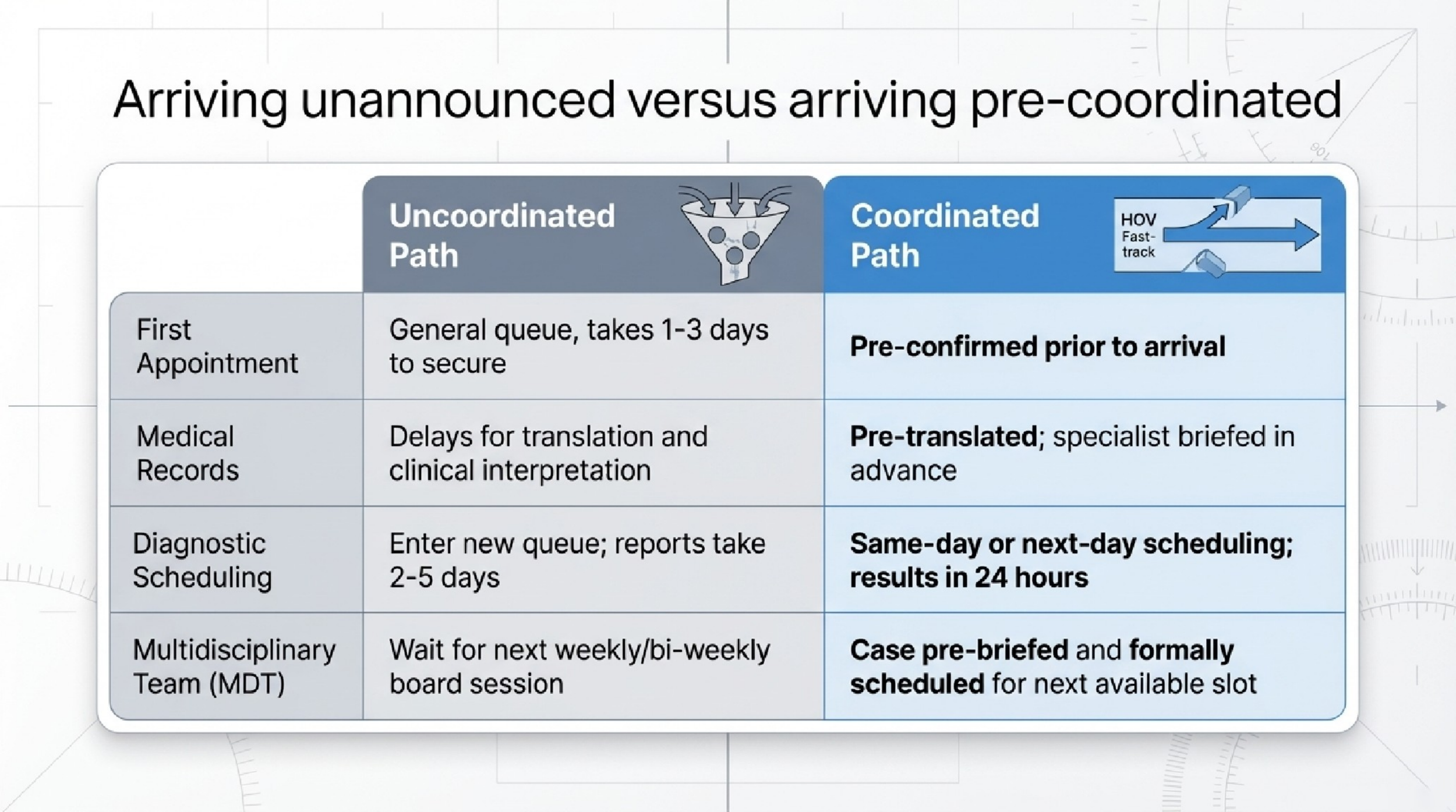
You arrive and join the general queue for a specialist appointment. Depending on the department and the physician's schedule, that first appointment may take one to three days to secure. The specialist reviews your records — but if those records are in a foreign language or format, additional time is needed for translation and clinical interpretation. If the doctor wants new imaging or lab work, you enter another scheduling queue. Reports take two to five days to process. A follow-up consultation is then needed to discuss the results.
For complex cases involving multiple departments, a Multidisciplinary Team (MDT) review may be required. MDT boards at top Beijing hospitals typically convene on a weekly or bi-weekly schedule. If you miss one session, you wait for the next.
None of this reflects inefficiency on the hospital's part. These are world-class institutions managing enormous patient volumes with impressive infrastructure. The delays are a coordination problem, not a capability problem — and coordination is exactly what can be solved before you fly.
The Coordinated Trip: What Three Days in Beijing Can Look Like
When a patient arrives in Beijing with appointments pre-confirmed, medical records pre-translated, and the clinical team already briefed on the case, the timeline compresses significantly.
Day 1: Specialist consultation. The physician has already reviewed a summary of your case. The appointment is focused and productive. If new imaging is needed, it is scheduled for the following morning.
Day 2: Diagnostics completed. For most standard cases — including MRI, CT, PET-CT, and core lab panels — same-day or next-day scheduling is achievable when arranged in advance. Results for many tests are available within 24 hours.
Day 3: Follow-up consultation and clinical recommendation. The specialist presents findings, answers questions, and outlines the recommended treatment path. You leave Beijing with a clear picture of your options. For cases requiring MDT review, pre-coordination means the board can be briefed ahead of your arrival, with your case formally scheduled for the next available session rather than entered into a general queue after you land.
This is not an optimistic scenario. It is what coordinated medical travel to Beijing actually looks like.
When a Longer Stay Makes Sense
A three-day evaluation trip is the starting point, not the ceiling. What happens after your initial evaluation depends entirely on your clinical situation and your own choices.
If surgery is recommended and you decide to proceed in Beijing, your stay will extend accordingly. A realistic breakdown:
Pre-operative preparation typically takes three to seven days — hospital admission, surgical clearance testing (ECG, blood panels, imaging review, anesthesia assessment), and pre-surgical prep.
The inpatient stay following surgery is generally five to fourteen days, depending on the procedure.
Post-operative ground recovery before you are cleared to fly varies by procedure type. Your surgeon will determine when it is safe for you to travel. This phase should not be rushed, and your treating physician's guidance takes precedence over any general estimate.
If surgery is not yet on the table, or if you are traveling for a second opinion or a diagnostic evaluation only, a short trip of three to five days is typically sufficient — and you can return home with a clear clinical picture and a documented treatment recommendation.
The Biggest Planning Mistake
The most common and costly error international patients make is booking a non-refundable round-trip ticket before anyone in China has reviewed their case. If you arrive expecting a consultation and your doctor determines you need surgery, a five-day itinerary becomes a logistical crisis.
The right approach is to understand what your case is likely to involve before you commit to travel. A remote case review — where your records are assessed by a specialist in Beijing before you book anything — gives you the information you need to plan your trip with realistic expectations.
How PandaMed Supports Your Planning
PandaMed works with international patients who are considering medical care in Beijing. Our role is not to replace the clinical judgment of your physicians — it is to make sure that by the time you land, everything that can be arranged in advance already has been.
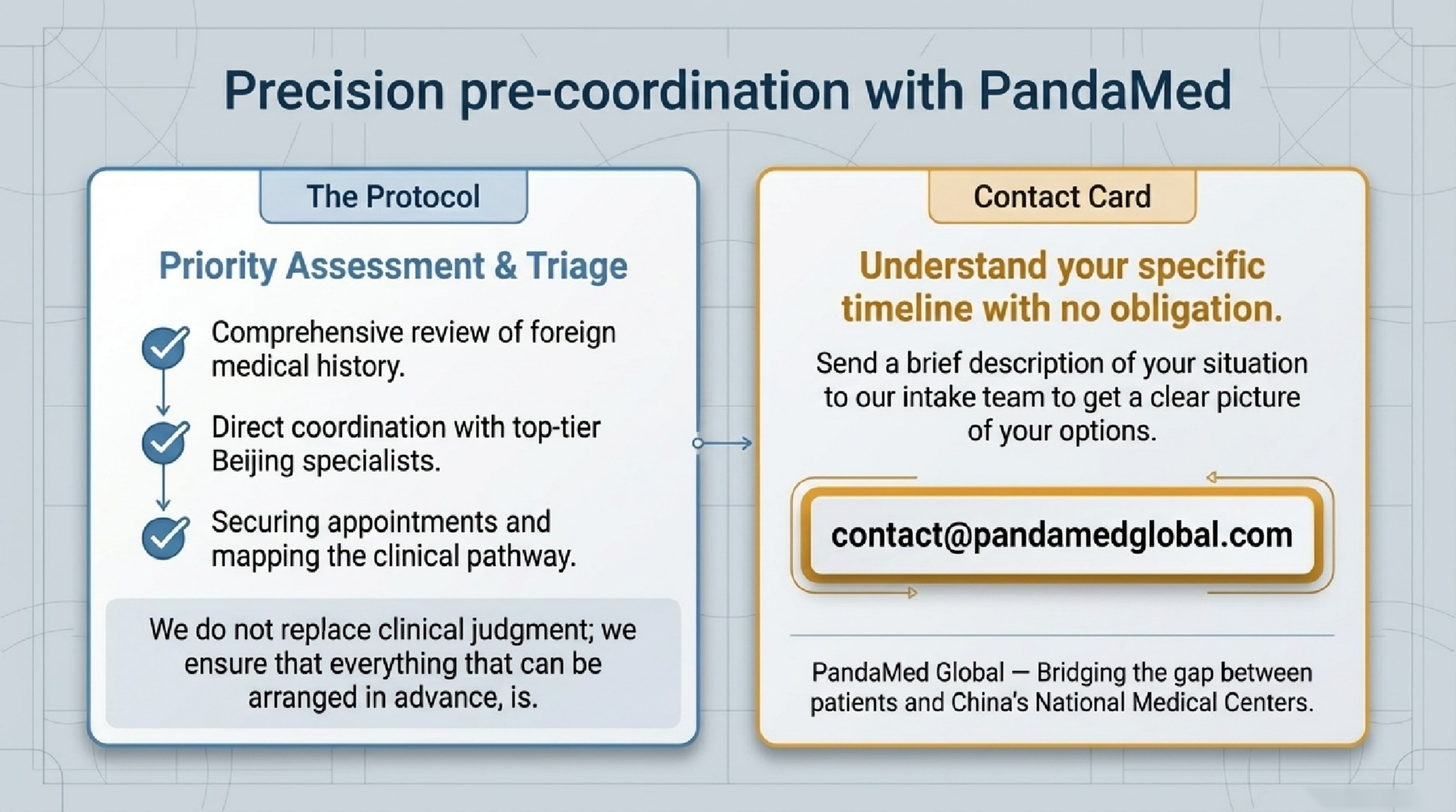
Through our Priority Assessment & Triage service, our team reviews your medical history, coordinates with relevant specialists in Beijing, and helps you understand what your trip is realistically likely to involve. If your case warrants a consultation, we work to have your appointment confirmed, your records prepared, and your clinical pathway mapped before you fly.
The result is a trip where your days in Beijing are spent on medicine — not on administration.
If you are unsure whether traveling to Beijing is the right next step, or if you want a clearer picture of what your specific situation might require, that is exactly the kind of question we help you work through first. Reach out to our team at contact@pandamedglobal.com with a brief description of your situation. There is no obligation — just a clearer picture of your options.
Frequently Asked Questions
Should I book a one-way or round-trip flight?
Many countries and airlines require proof of onward travel — a return ticket — as a condition of boarding or visa issuance. The safest approach is to book a flexible or fully refundable round-trip ticket, using the upper end of your estimated stay as the return date. This gives you a documented itinerary while preserving the option to adjust if your treatment timeline changes.
What happens if my treatment takes longer than my visa allows?
If medical complications arise or your recovery extends beyond your original visa validity, your treating hospital can issue updated medical documentation. You or your designated liaison can present this documentation to the local Exit-Entry Administration Bureau (Public Security Bureau) to apply for a visa extension. This is a standard process for medical cases.
Can I do follow-up visits remotely after I return home?
In many cases, yes. Once a Chinese specialist has treated you and an established patient relationship exists, routine follow-ups — including medication adjustments and review of new scans taken in your home country — can often be handled via telemedicine. This can reduce or eliminate the need for a second international trip for ongoing monitoring.
How soon can I fly after major surgery?
This depends on the specific procedure. Minor surgical interventions may allow air travel within a week. Abdominal, thoracic, or neurological surgeries may require a ground recovery period of three to six weeks or longer. Always obtain explicit written clearance from your treating surgeon before booking a return flight. Do not rely on general estimates — your physician's assessment of your individual recovery status is the only guidance that applies to your case.
This article is intended for general informational and planning purposes. Medical timelines vary significantly based on individual diagnosis, disease status, treatment history, and physician evaluation. The scenarios described above represent general patterns and do not constitute a guarantee of any specific timeline for any individual patient.
