
Can You Use Foreign Health Insurance in China for Medical Treatment?
If you are considering medical treatment in Beijing or another major city in China, one of the first practical questions is how payment will work. Many international patients ask whether they can use foreign health insurance in China for medical treatment.
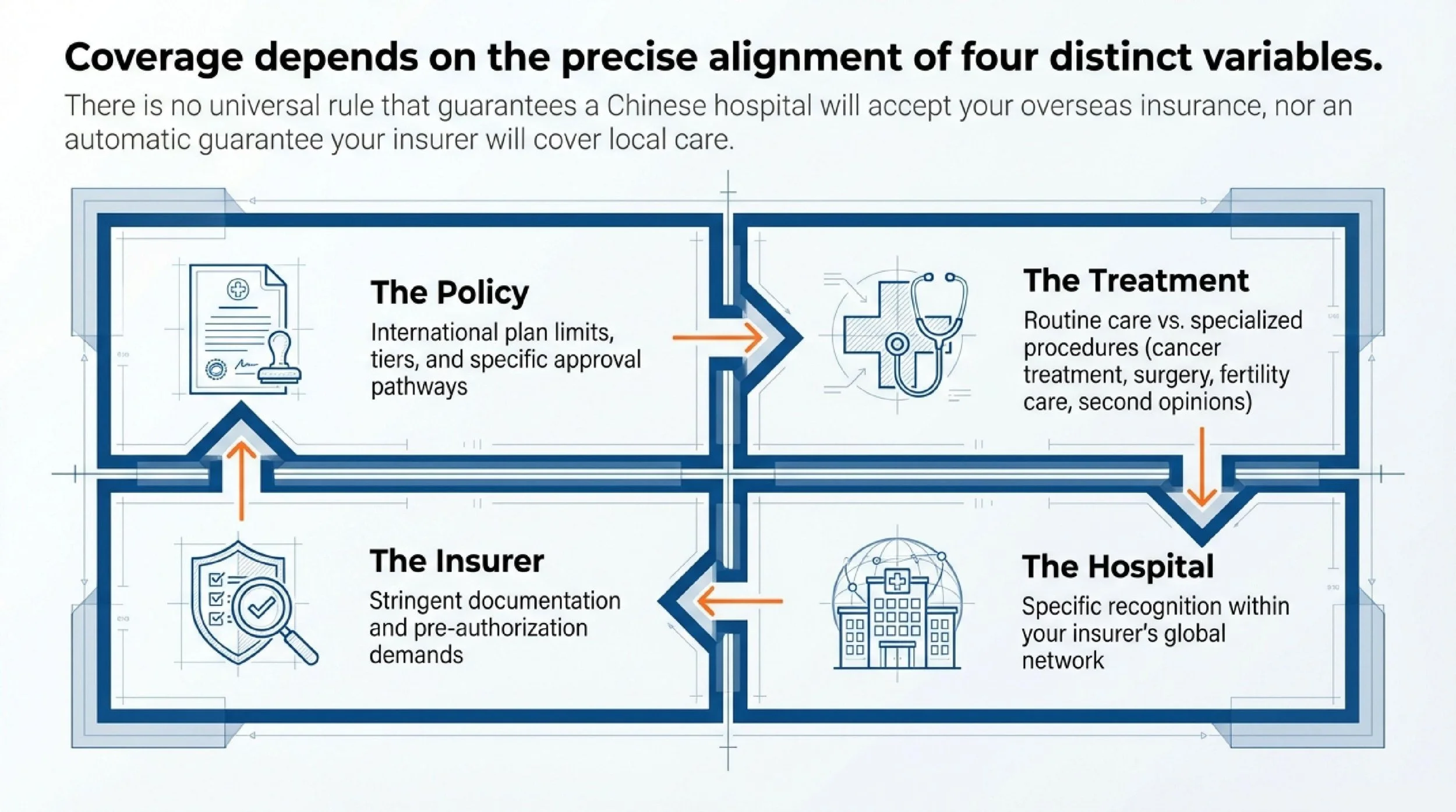
The short answer is simple: it depends on the specific policy, the type of treatment, the hospital, and the insurer’s requirements.
There is no universal rule that guarantees a hospital in China will accept your overseas insurance, and there is no automatic guarantee that your insurer will cover care received in China. In many cases, the answer depends on whether you are seeking emergency care or planned treatment, whether the hospital is recognized within your insurer’s network, and whether pre-authorization is required before care begins.
Emergency Care and Planned Treatment Are Usually Handled Differently
One of the first things to clarify with your insurer is why you are receiving care in China.
Many travel insurance plans and some domestic health plans may offer limited coverage for unexpected emergency treatment while abroad. That is different from traveling to China specifically for medical care, such as cancer treatment, surgery, specialist evaluation, fertility care, rehabilitation, or a second opinion. In insurance terms, that is often treated as planned treatment abroad.
Planned treatment outside your home country is not included in every policy. Some international health insurance plans may include it, while others may exclude it or limit it to certain hospitals, conditions, or approval pathways. Before you travel, it is important to ask your insurer whether your plan includes planned overseas treatment, and if so, under what conditions.
Do Hospitals in China Accept International Insurance?
In practice, this often depends less on “China” as a whole and more on the specific hospital and department.
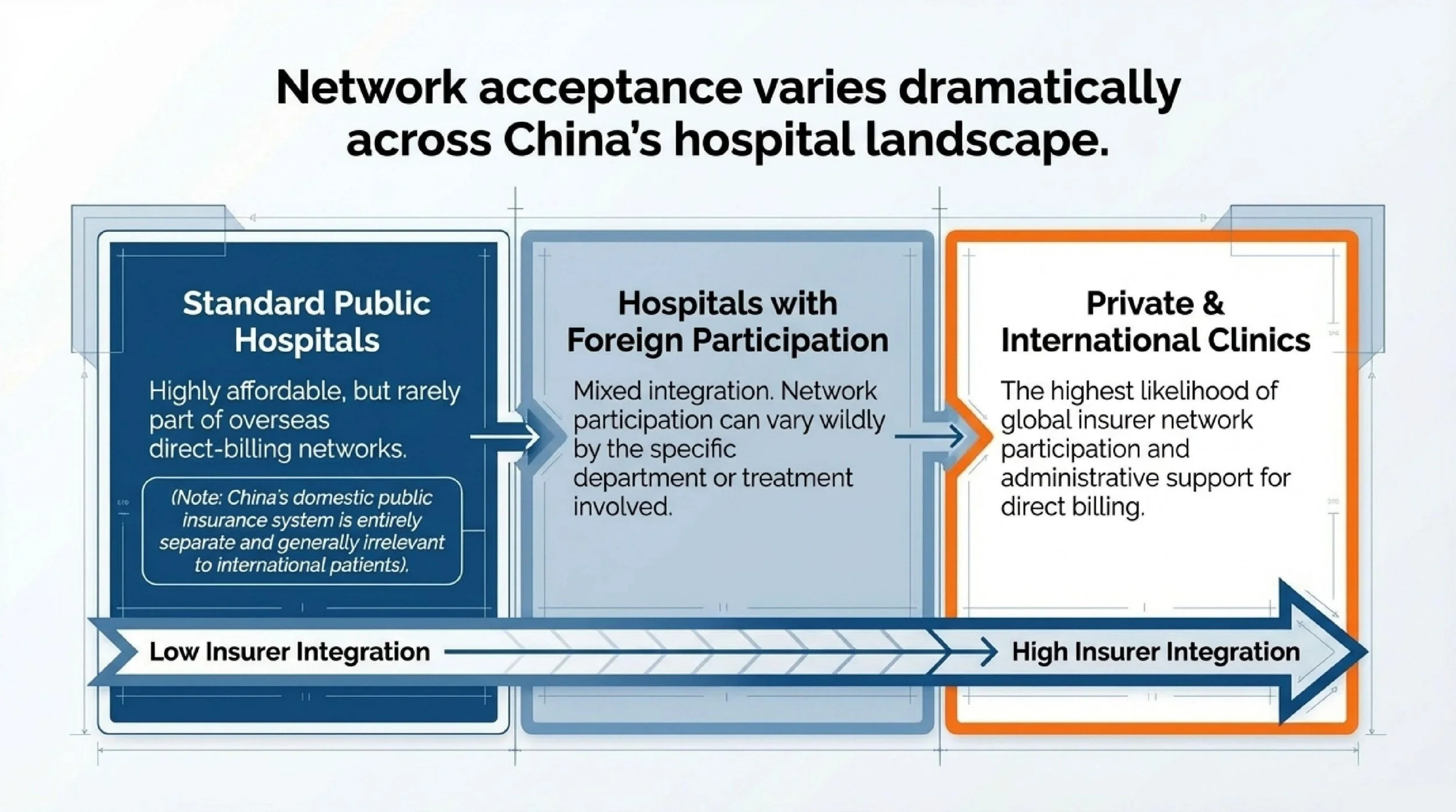
In Beijing, some private hospitals, international clinics, and certain hospitals with foreign participation may be more likely to work with global insurers or provide administrative support for direct billing under some plans. By contrast, many standard public hospitals, while often more affordable, may not be part of an overseas insurer’s direct billing network.
That said, network participation is not universal and should never be assumed. It can vary based on the insurer, the policy tier, the hospital entity, the department involved, and the type of treatment being requested. Even within the same city, one facility may be recognized by your insurer while another is not.
It is also important not to confuse international commercial insurance with China’s domestic public medical insurance system. China’s public insurance system follows its own eligibility and reimbursement rules and is generally more relevant to people formally enrolled in that system than to international patients traveling from abroad for care.
Pre-Authorization May Be Required Before Treatment
Even if your policy includes international medical coverage, many insurers still require pre-authorization, especially for planned treatment.
This usually means the insurer wants to review the diagnosis, proposed treatment plan, estimated costs, and the hospital or physician involved before approving coverage consideration. If pre-authorization is required and not obtained in advance, a later claim may be reduced or denied, depending on the policy terms.
For that reason, patients should not assume they can simply receive care first and sort out insurance later. Before traveling, it is wise to confirm:
whether pre-authorization is needed,
which documents the insurer wants to review,
whether the hospital must be in-network,
and whether the insurer needs a formal treatment estimate before any approval decision.
Direct Billing vs. Pay-and-Claim
Even when coverage may exist, the payment process can work in very different ways.
Some hospitals and clinics may support direct billing, meaning the provider bills the insurer directly if the hospital is recognized within the insurer’s network and the treatment has been approved under the policy terms. This is often the simplest arrangement for patients, but it is not available in every case.
In other situations, patients may need to follow a pay-and-claim model. That means the patient pays the bill upfront, collects the required documentation, and later submits a reimbursement claim to the insurer. Whether reimbursement is available, and for how much, depends on the policy terms, claim review, exclusions, deductibles, and documentation quality.
Because of this, patients should ask in advance not only “Am I covered?” but also “How is payment supposed to work?”
Documentation Matters More Than Many Patients Expect
If you may need to file a reimbursement claim, documentation becomes extremely important.
Chinese hospitals generally issue formal billing and medical documents in formats that may differ from what international patients are used to. Insurers may ask for:
official invoices or tax receipts,
itemized billing details,
medical records,
physician notes or discharge summaries,
test results,
and sometimes certified English translations.
One document that often matters in China is the official tax invoice, or fapiao. A standard card receipt alone may not be enough for an insurance claim. Because each insurer has its own claims process, patients should confirm exactly which documents are required and whether translated records must be submitted in a particular format.
Pre-Existing Conditions and Policy Exclusions Still Apply
Patients should also review the policy language related to pre-existing conditions, waiting periods, exclusions, and non-standard therapies.
Some international plans may limit coverage for conditions diagnosed before enrollment, or they may require a longer approval process for high-cost treatments. In some situations, insurers may also decline coverage for treatments they classify as investigational, experimental, or outside standard policy definitions in the patient’s home market.
This does not mean treatment in China is unavailable. It simply means that insurance applicability and reimbursement are policy-dependent, and the patient should verify these points directly with the insurer before making travel or treatment decisions.
What International Patients Should Ask Their Insurance Company
Before making arrangements for treatment in China, it may help to ask your insurer the following practical questions:
Does my policy cover planned treatment abroad, or only emergency care outside my home country?
Does coverage apply in China specifically?
Do I need pre-authorization before consultation, testing, admission, surgery, or treatment?
Does the hospital need to be in-network?
Will the insurer support direct billing, or will I need to pay first and submit a claim later?
What documents are required for reimbursement?
Are English translations required for Chinese medical records or invoices?
Do any exclusions apply because of a pre-existing condition, waiting period, or treatment classification?
These questions can reduce uncertainty and help patients avoid unexpected out-of-pocket costs.
How PandaMed Can Help
PandaMed does not make insurance decisions, guarantee reimbursement, or act as an insurance broker. Final coverage decisions are made by the insurer according to the policy terms and the claim review process.
What PandaMed can do is help patients checking the insurance net work in China.
For patients considering treatment in Beijing, our team can help organize the medical information that insurers often want to see in advance, such as case summaries, translated records, proposed hospital options, and estimated treatment-related information when available. This can make it easier for patients and families to confirm what their insurer may require before travel.
If you are trying to understand what treatment information, hospital documentation, and cost details you may want to clarify with your insurer before coming to China, PandaMed can help you prepare the right questions and supporting materials.
If you would like to discuss your case, you are welcome to contact PandaMed at contact@pandamedglobal.com.
