
How to Verify if Your Insurance Covers Medical Treatment in China
If you are planning medical treatment in China, one of the first questions you may have is whether your insurance can be used there. That sounds like a simple question, but in practice it usually is not. The answer may depend on the type of treatment, the hospital, whether prior approval is required, and how payment and claims are handled.
That is why asking, “Am I covered in China?” is usually not enough. A more useful approach is to ask more specific questions in the right order. If you understand what information your insurer is likely to need, and if you already have a clearer sense of your likely treatment plan, you are much more likely to get a meaningful answer before you travel.
Start by Clarifying Planned Treatment vs. Emergency Care
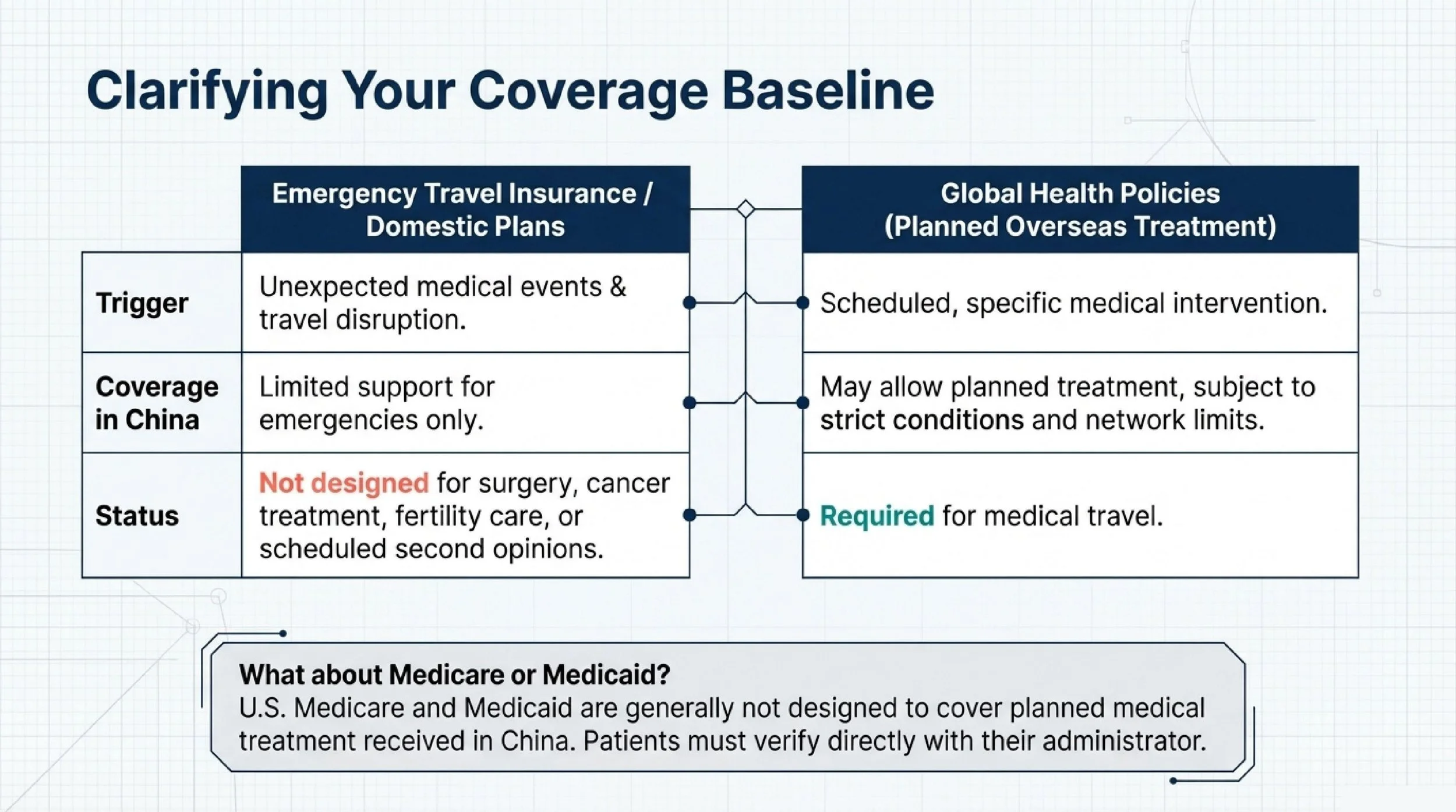
The first thing to confirm is whether your situation is being treated as emergency care abroad or planned treatment abroad. Many travel insurance policies and some domestic health plans may offer limited support for unexpected emergency care while you are overseas. That is very different from traveling to China specifically for surgery, cancer treatment, fertility care, specialist evaluation, rehabilitation, or a second opinion.
From an insurance perspective, this kind of travel is often classified as planned overseas treatment. Not every policy includes that. Some plans may allow it under certain conditions, while others may exclude it, limit it to certain hospitals, or require advance approval before treatment begins. For that reason, the first question to ask your insurer is not simply whether China is covered. It is whether your policy includes planned medical treatment outside your home country, and if so, under what conditions.
Prepare Before You Call
Insurance conversations tend to go much more smoothly when you can describe the likely treatment path with some specificity. Insurers often want more than a destination city or a hospital name. They may ask what the diagnosis is, what kind of treatment is being proposed, which hospital or department is involved, how long the stay may last, and what the estimated costs could be.
If you do not yet have at least a preliminary treatment plan, it can be difficult for the insurer to give you a clear answer. This is one reason many patients find that insurance questions become much easier once they already have a more realistic picture of the likely medical pathway.
Ask Whether Pre-Authorization Is Required
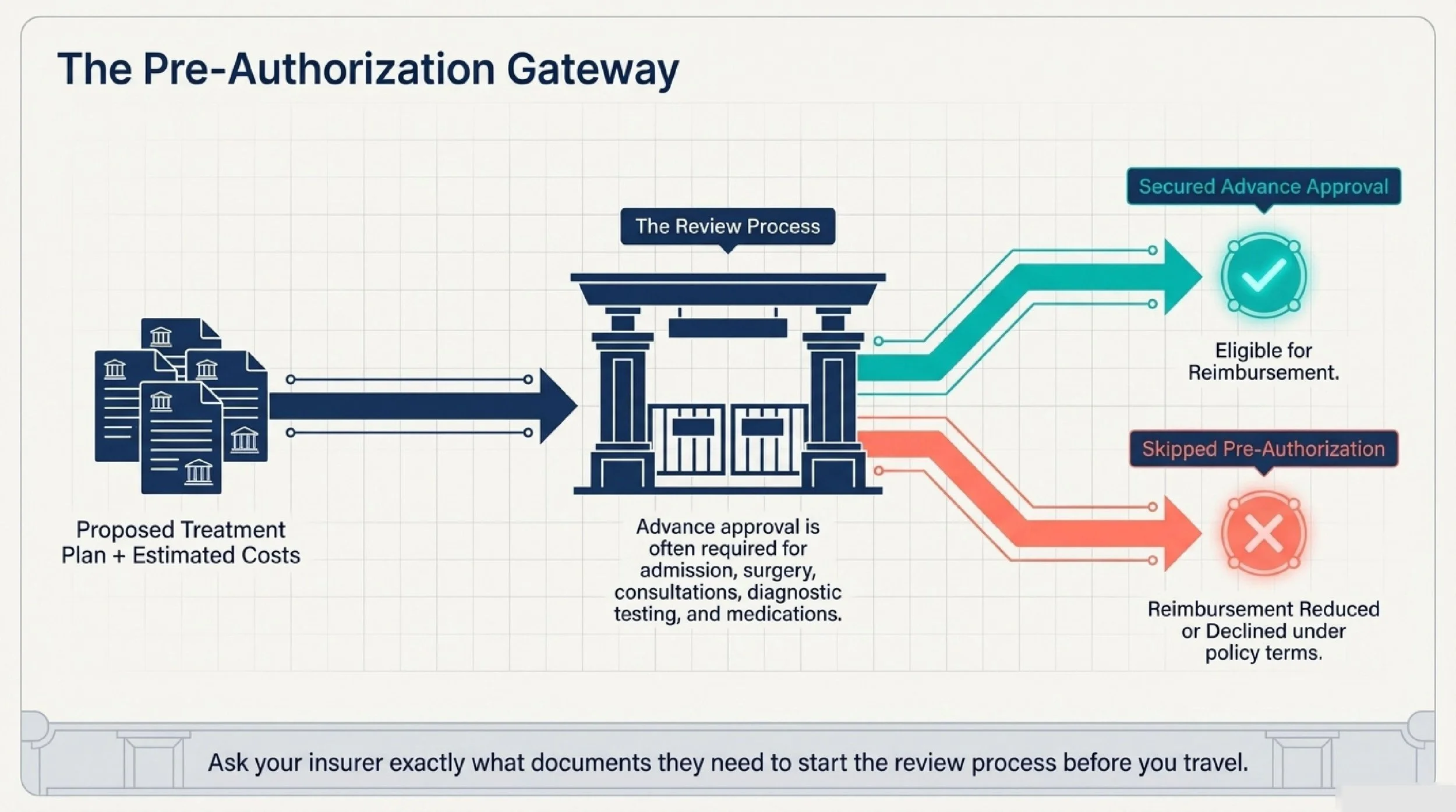
When you speak with your insurer, one of the first practical issues to clarify is whether prior approval, or pre-authorization, is required. For planned treatment abroad, this is often a major step. Ask whether approval is needed only for admission and surgery, or also for consultations, diagnostic testing, medication, and follow-up care. You should also ask exactly what documents they want to start that review process.
In many cases, insurers will want a proposed treatment plan and an estimate of expected costs before they make any decision. If pre-authorization is required and not completed in advance, later reimbursement may be reduced or declined under the policy terms.
Ask How Different Parts of Care Are Handled
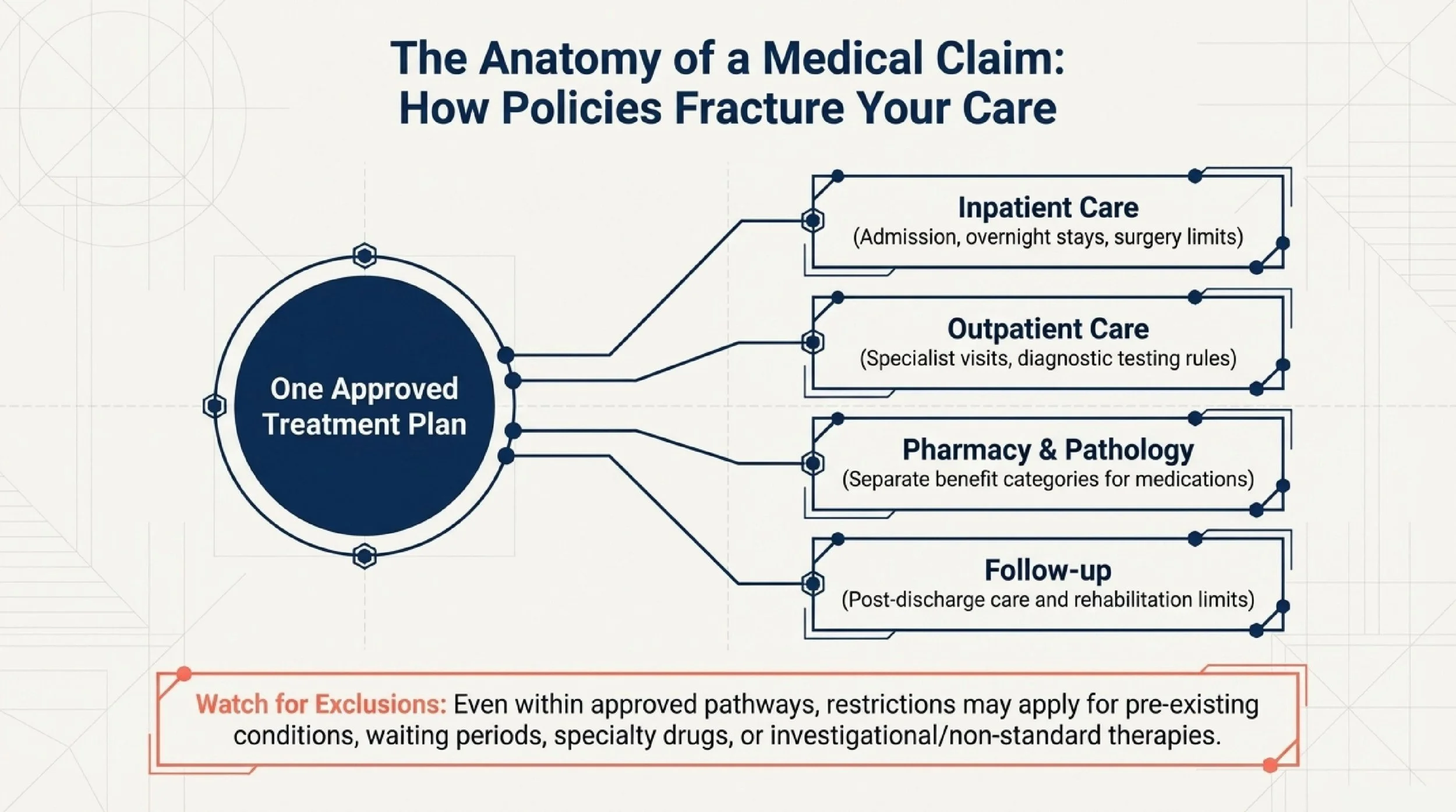
It is also important to ask how the policy handles inpatient and outpatient care, because the rules may not be the same. A plan may apply one set of limits to outpatient specialist visits and diagnostic testing, and another set of rules to hospital admission, overnight stays, or inpatient procedures.
The same is true for different parts of treatment. Consultations, imaging, surgery, medications, pathology, and follow-up treatment may be reviewed under separate benefit categories or sub-limits. A patient may assume that one approved treatment pathway is covered as a whole, when in fact the insurer may evaluate different components separately. Asking about this early can help reduce confusion later.
Ask How Payment Works in Practice
Even if a policy may apply, that does not necessarily mean the hospital will bill the insurer directly. Some hospitals may support direct billing under certain plans, while other situations may work on a pay-and-claim basis, where the patient pays upfront and later submits a reimbursement claim.
This is why patients should ask not only whether the treatment may be covered, but also whether the hospital must be in-network, whether direct billing is available, whether pre-approval is needed for that billing arrangement, and how long reimbursement usually takes if the patient pays first. If treatment is likely to involve substantial costs, it is also wise to ask how the insurer handles foreign currency conversion and whether reimbursement is calculated based on the treatment date or the claim processing date.
Ask About Hospital Networks in China
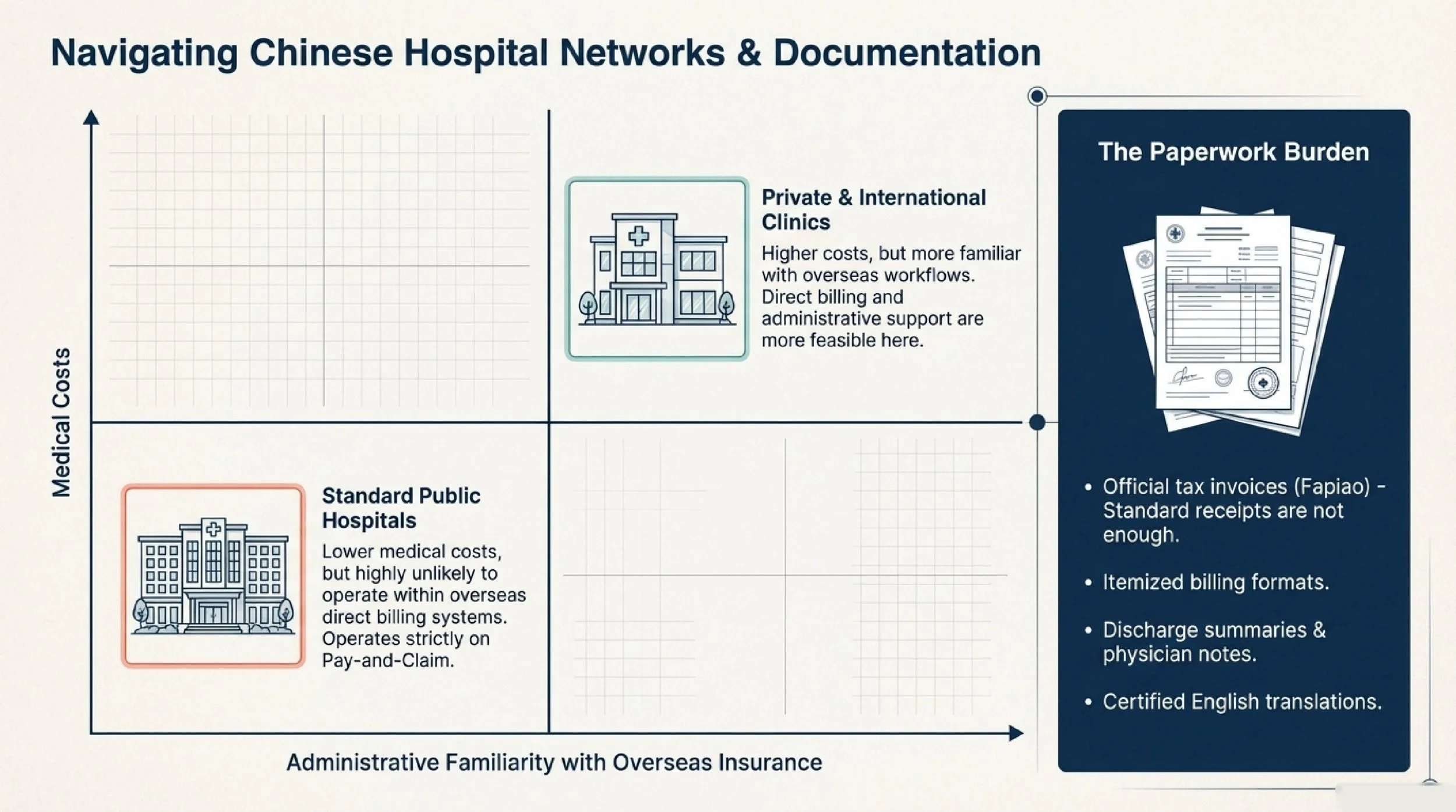
Hospital type can affect how practical insurance use may be. In Beijing, some private hospitals, international clinics, and certain hospitals with foreign participation may be more familiar with overseas insurance workflows, including direct billing or insurance-related administrative support in some cases. Many standard public hospitals may have lower medical costs, but they are often less likely to operate within overseas direct billing systems.
That does not mean one setting is always better. It means the insurance process may differ depending on the hospital environment, the insurer, the physician pathway, and the type of care being planned. It is worth asking your insurer whether they have a preferred provider list, network hospital list, or recommended billing arrangement for your destination city.
Confirm Documentation Requirements Early
Claims for treatment in China often depend heavily on documentation. Ask your insurer exactly what they will require from the hospital. This may include official invoices or tax receipts, itemized billing, medical records, discharge summaries, physician notes, test results, and in some cases certified English translations.
One document that often matters in China is the official tax invoice, or fapiao. A standard payment receipt or card slip may not be enough for some insurance claims. It is also important to ask whether your insurer accepts Chinese hospital billing formats and whether translated records need to follow a specific standard.
Review Exclusions and Limits
Even if your policy includes international treatment, exclusions may still apply. Ask whether any pre-existing condition rules, waiting periods, condition-specific exclusions, limits for specialty drugs or advanced diagnostics, or restrictions related to investigational or non-standard therapies could affect your case.
These issues do not always prevent care, but they can affect whether a treatment plan is approved, partially reimbursed, or excluded under the policy.
Why a Clear Treatment Path Matters
Many patients try to verify insurance too early, before they know what treatment they may actually need. That is understandable, but it often leads to vague answers. Insurers usually respond more clearly when the case details are more concrete. That may include the diagnosis, likely treatment path, expected timeline, approximate costs, and the hospital setting being considered.
In other words, insurance questions become much easier to ask when you already have a clearer picture of the likely treatment plan.
How PandaMed Can Help
PandaMed does not make insurance decisions, guarantee reimbursement, or act as an insurance broker. Final coverage decisions remain with the insurer under the policy terms and claims review process.
What PandaMed can do is help patients prepare for those conversations in a more informed way. For patients considering treatment in Beijing, PandaMed can help organize medical records, clarify case details, support translation, and assist with identifying hospital and physician pathways that may be relevant to the proposed treatment plan.
Importantly, PandaMed’s network includes hospitals and care settings that may be more familiar with overseas insurance processes in some cases. Based on the proposed treatment pathway, PandaMed can help patients understand which hospital settings may be more practical to confirm with their insurer, including where insurance-related administrative support may be more feasible. This does not mean coverage is guaranteed. It means patients can approach their insurer with a more specific, better-structured set of questions.
If you are trying to understand what your insurer may need before you travel to China for treatment, PandaMed can help you prepare the medical information, hospital context, and treatment details that may make that conversation clearer. For general case coordination inquiries, you are welcome to contact PandaMed at contact@pandamedglobal.com.
FAQ
Will Medicare or Medicaid cover treatment in China?
In general, U.S. Medicare and Medicaid are not designed to cover planned medical treatment received in China. Coverage rules may be limited and situation-specific, so patients should verify directly with the relevant program, administrator, or insurer.
Can I buy travel insurance just for this trip and use it for planned treatment?
In many cases, standard travel insurance is intended for unexpected medical events and travel disruption rather than planned treatment abroad. Patients considering scheduled care in China should review the policy language carefully and confirm directly with the insurer what type of treatment, if any, may be included.
What if the hospital asks for a deposit upfront?
It could happen. Even when an insurer has approved treatment in principle, some hospitals may still require a deposit, advance payment, or financial guarantee before admission or before certain services begin. Patients should clarify payment procedures with both the hospital and the insurer in advance whenever possible.
