
Medical Travel to China Checklist for International Patients
A practical, step-by-step guide to preparing your documents, medications, payments, and travel logistics before coming to China for treatment.
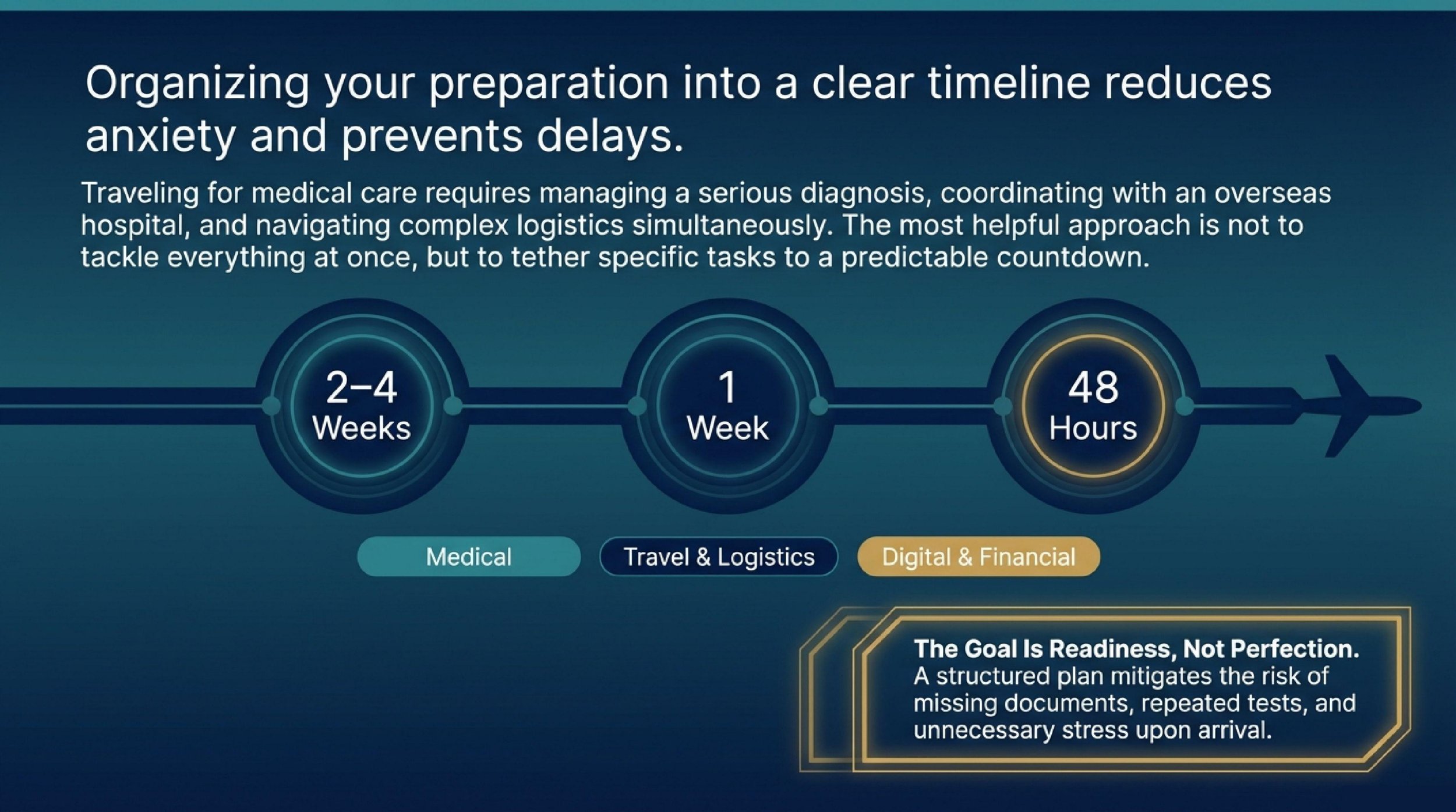
Traveling to another country for medical care is very different from planning a regular trip. You may be managing a serious diagnosis, coordinating with a hospital far from home, and trying to keep track of records, translations, payments, and travel logistics at the same time.
If you are searching for a medical travel to China checklist, you are likely already in the planning or execution stage. At this point, the most helpful approach is not to think about everything at once. It is to organize your preparation into a clear timeline.
A structured plan can reduce the risk of missing documents, repeated tests, admission delays, or unnecessary stress after arrival. Below is a practical guide to help international patients prepare before traveling to China for treatment.
2–4 Weeks Before Departure: Confirm the Core Medical and Travel Arrangements
This stage is about locking in the most important parts of the trip: identity documents, hospital coordination, medical records, and financial planning.
Confirm your passport, visa, and hospital paperwork
Before anything else, make sure your passport will remain valid well beyond your planned stay. Many travelers use a six-month buffer as a practical minimum, but you should also confirm the latest entry requirements based on your nationality and route.
You should also verify that you have the appropriate visa or entry documentation for your travel purpose, based on current consular requirements. Because entry rules may change, it is safer to confirm the current requirements directly with the relevant embassy, consulate, or official visa service rather than relying on general online advice.
On the medical side, make sure you have clear written confirmation from the hospital or care team. This may include an invitation letter, appointment confirmation, admission notice, or a preliminary treatment plan. You should know where you are going, when you are expected to arrive, and what the first step will be after landing.
Gather your medical records and identify what needs translation
One of the most important parts of China medical travel preparation is organizing your medical file before departure.
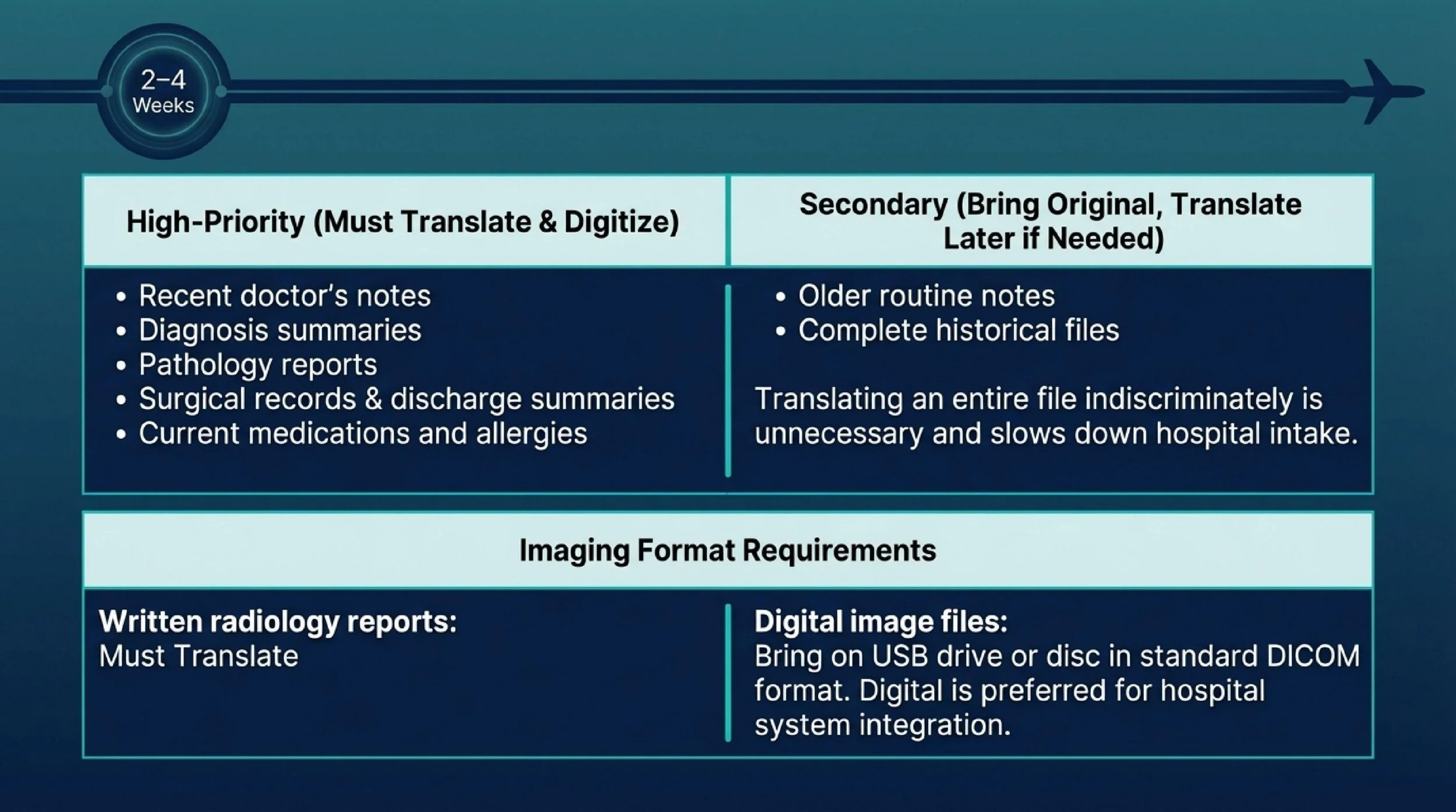
Start by collecting the documents that best explain your current condition and recent care. These often include recent doctor’s notes, diagnosis summaries, pathology reports, surgical records, discharge summaries, test reports, and a list of current medications and allergies.
If you have had imaging such as MRI, CT, PET-CT, ultrasound, or X-ray, try to obtain both:
the written radiology reports, and
the digital image files, ideally in a standard medical format such as DICOM on a USB drive or disc.
Not every page needs to be translated. In most cases, the highest-priority items are the documents that explain the diagnosis, staging or disease status, prior treatment history, and the most recent key findings. Translating the most relevant documents first is usually more useful than translating an entire file indiscriminately.
If you want to avoid missing documents, repeated tests, or confusion after arrival, PandaMed can help review your case file and preparation plan before you travel. Clarifying your records early can make the hospital process more efficient once you arrive in Beijing.
Review insurance, budgeting, and payment expectations
International patients should never assume overseas coverage is automatic. If you have international insurance, contact the insurer early and ask specific questions:
Is treatment in China covered under your plan?
Do you need pre-authorization?
Will the hospital need to issue certain billing codes or documents for reimbursement?
Are there exclusions for diagnostics, surgery, inpatient care, or follow-up services?
Even if you expect to self-pay, you should still clarify the hospital’s payment process in advance. Ask whether an upfront deposit is required, when payment is due, and which payment methods are usually accepted for international patients.
It is also wise to build a broader budget, not just for treatment itself, but for:
accommodation,
local transportation,
translation or interpretation support,
meals,
medications,
and possible schedule changes or a longer-than-expected stay.
1 Week Before Departure: Organize the Details That Affect Your Arrival
Once the major arrangements are confirmed, focus on the practical details that will shape your first few days in China.
Create one complete physical folder and one digital backup
Prepare a single, well-organized physical folder containing the documents you may need during travel or hospital intake. This often includes:
passport copy,
visa or entry documents,
hospital confirmation letter,
insurance information,
translated medical summaries,
medication list,
and emergency contacts.
At the same time, create digital backups of the same materials on your phone, a secure cloud service, or both. If possible, make sure at least one version is accessible offline in case you have connectivity issues after arrival.
This step sounds simple, but it can make a major difference. When records are scattered across email threads, chat apps, old photo albums, and multiple PDF files, delays become much more likely.
Set up the essential apps before you leave home
China relies heavily on mobile platforms for communication, transportation, payments, and coordination. It is much easier to set these up before departure than after arrival.
For many international patients, the most useful apps include:
Communication apps
WeChat is widely used for everyday communication and is often helpful for staying in contact with translators, coordinators, drivers, or local support contacts.
Mobile payment apps
Alipay and WeChat Pay are commonly used in daily life. International card compatibility has improved, but availability and setup options may vary by bank, card type, phone region, and current platform policies. It is best to test your setup before departure and carry backup payment options as well.
Translation and navigation apps
A reliable translation app with offline Chinese support can be extremely useful. For navigation, travelers should be aware that Google Maps may not function reliably in China. Apple Maps or Chinese Gaode mapping platforms may be more practical, depending on your device and familiarity.
Pack your routine medications carefully
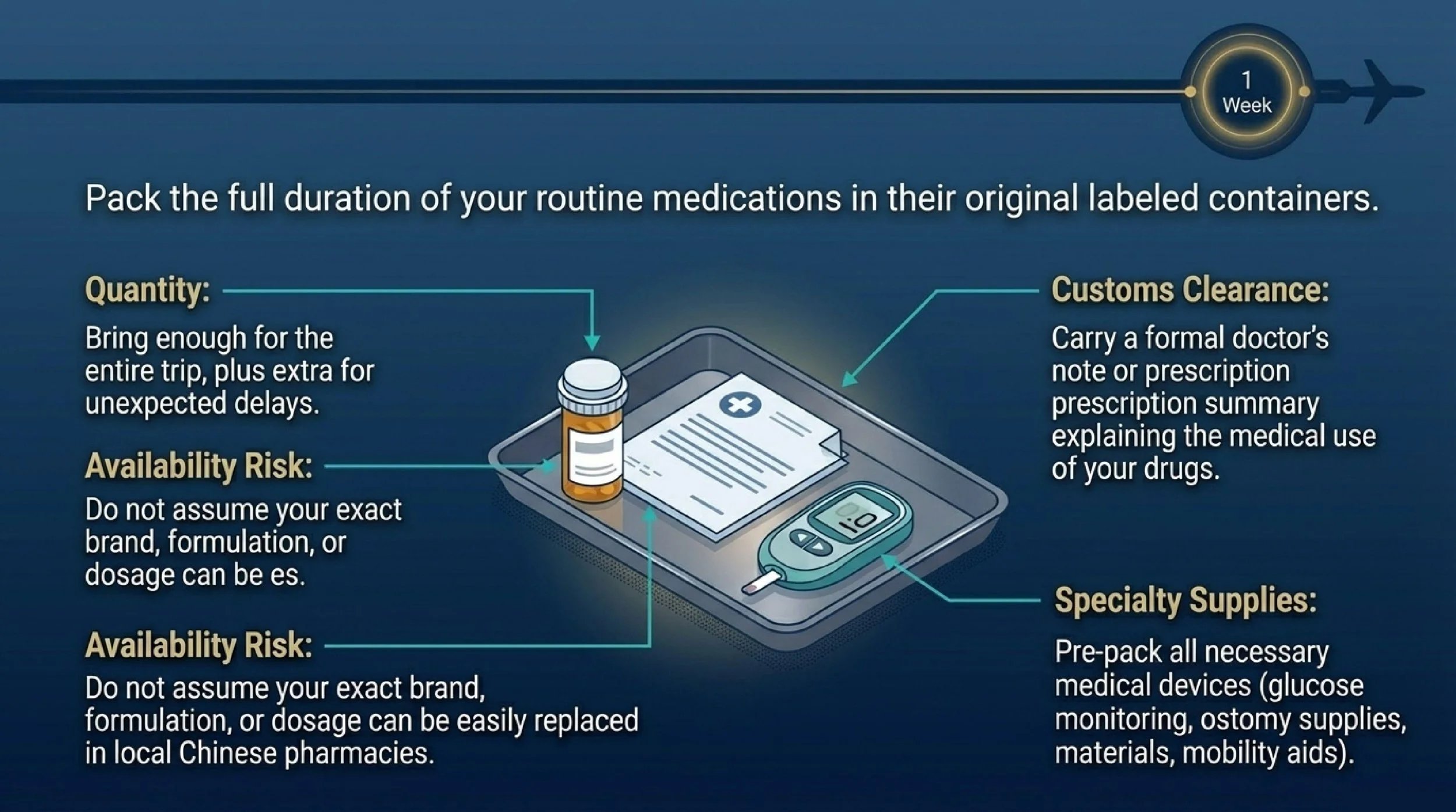
Bring enough of your regular prescription medications to cover the full trip, plus extra in case of delays. Do not assume your exact medication, dosage, or brand will be easy to replace locally.
Keep medications in their original labeled containers whenever possible. It is also helpful to carry a doctor’s note or prescription summary, especially if you are traveling with specialty medications or items that may require explanation during security or customs review.
If you rely on any medical devices or supplies, prepare those in advance as well. That may include glucose monitoring supplies, ostomy supplies, injection materials, or mobility aids.
If you are unsure whether your records, medication list, or translated summaries are complete enough for the first hospital review, PandaMed can help you organize the essentials before travel so your arrival is more predictable and less stressful.
48 Hours Before Departure: Do the Final Check
The last two days should be about verification, not scrambling.
Keep your key documents in your carry-on
Your passport, visa or entry documents, hospital paperwork, medical summary, imaging reports, medication list, and emergency contacts should stay with you in your carry-on bag, not in checked luggage.
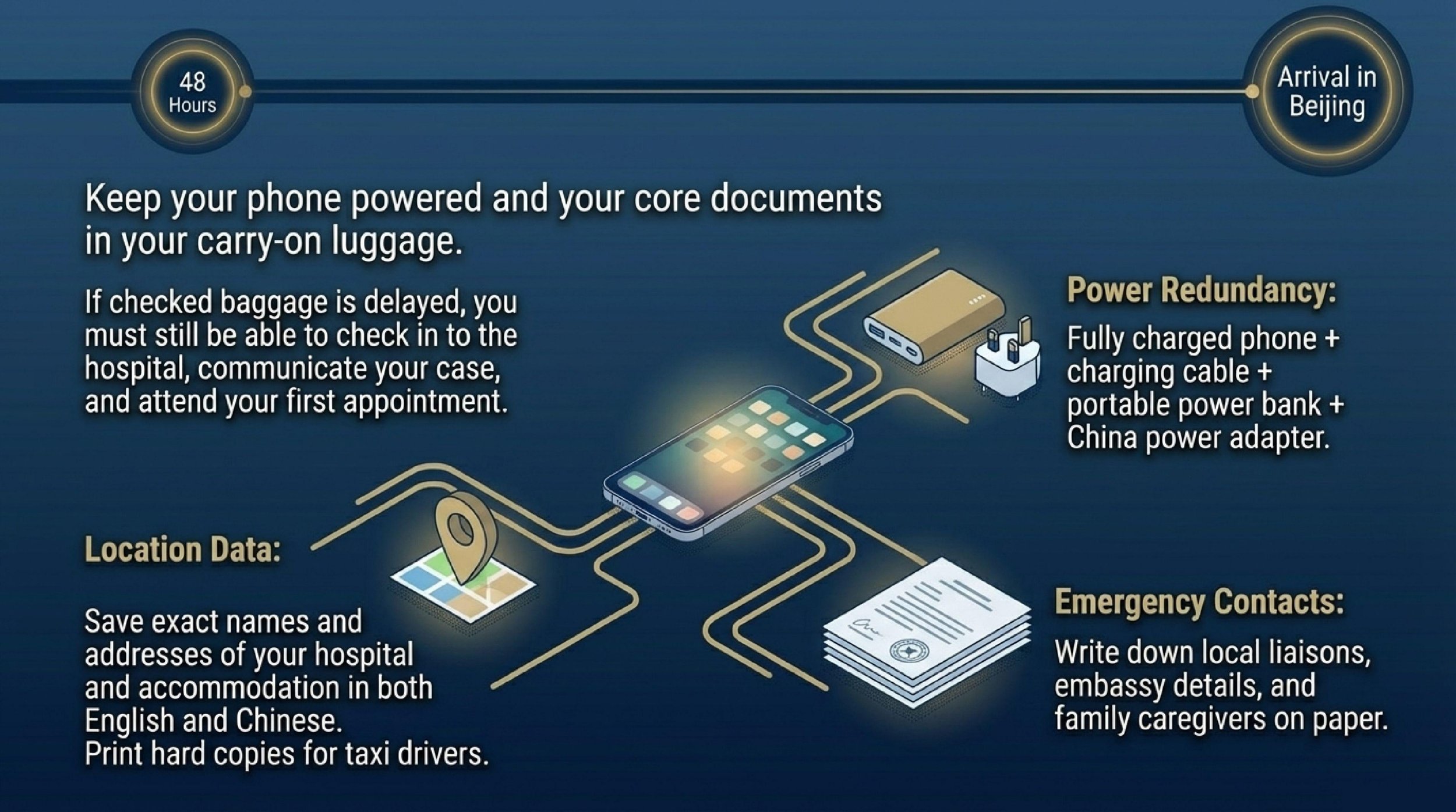
If checked baggage is delayed, you should still be able to arrive, check in, communicate your case, and attend your first medical appointment.
Prepare for phone, power, and navigation needs
Your phone may become one of your most important tools after arrival. You may need it for translation, messaging, payments, directions, ride-hailing, document access, and hospital communication.
Before departure, make sure you have:
a fully charged phone,
a charging cable,
a portable power bank,
and a suitable power adapter for China.
It is also smart to save the exact names and addresses of your hospital and accommodation in both English and Chinese. Printed copies are useful in case your phone battery runs low or a driver needs to see the address directly.
Write down your emergency and support contacts
Keep a written list of important contact information, including:
a family member or caregiver,
your hospital contact or liaison,
your local accommodation details,
your embassy or consulate information,
and any support person helping with your arrival or case coordination.
This small step can be surprisingly helpful when you are tired, jet-lagged, or navigating an unfamiliar environment.
A Practical Reminder: The Goal Is Not Perfection, but Readiness
Most international patients do not need to solve every possible problem before boarding the plane. What matters more is that your key records are organized, your first hospital steps are clear, your medications are packed, and your communication and payment tools are ready.
The smoother your preparation is before departure, the less likely you are to lose time after arrival.
How PandaMed Can Help Before You Travel
Good preparation can reduce confusion, unnecessary back-and-forth, and avoidable delays after landing. For many international patients, one of the hardest questions is not whether they want to seek care in China, but whether their records are actually organized well enough for a Chinese doctor or hospital team to act on them.
PandaMed supports international patients traveling to Beijing by helping them organize records, review preparation gaps, and clarify what may be needed before the first stage of hospital contact. Our Priority Assessment & Triage is designed to help families reduce uncertainty before travel, especially when records are incomplete, scattered, untranslated, or difficult to interpret across systems.
If you would like help reviewing your preparation plan before departure, you are welcome to contact PandaMed at contact@pandamedglobal.com.
FAQ
Do I really need printed copies of my medical records?
Yes, printed copies are still useful. Digital files are essential, but hard copies of your most recent diagnosis summary, pathology report, treatment summary, and key translations can help if there are compatibility issues, access problems, or delays during hospital intake.
Can I rely only on my credit card in China?
Not always. Some hospitals and larger providers may accept international credit cards, but everyday expenses in China often rely more heavily on mobile payment platforms. It is wise to prepare more than one payment option before arrival.
Should I bring original imaging films or just digital files?
If you have the original films, bringing them may be helpful. However, digital scan files and written reports are often more practical for review, especially if the receiving medical team needs to load the images into their own systems.
Can I buy my regular prescription medications in China?
You should not assume your exact brand, formulation, or dosage will be available. Bring enough of your regular medications for the full trip, plus extra if possible, and carry documentation explaining their medical use.
