
Should You Translate Medical Records Before Coming to China?
Not every page needs to be translated, but the right records should be clear, organized, and easy for a China hospital team to review.
If you are preparing to travel internationally for healthcare, one of the most common and stressful questions is whether you need to translate your medical records before coming to China.
The short answer is yes—but probably not as much as you think.
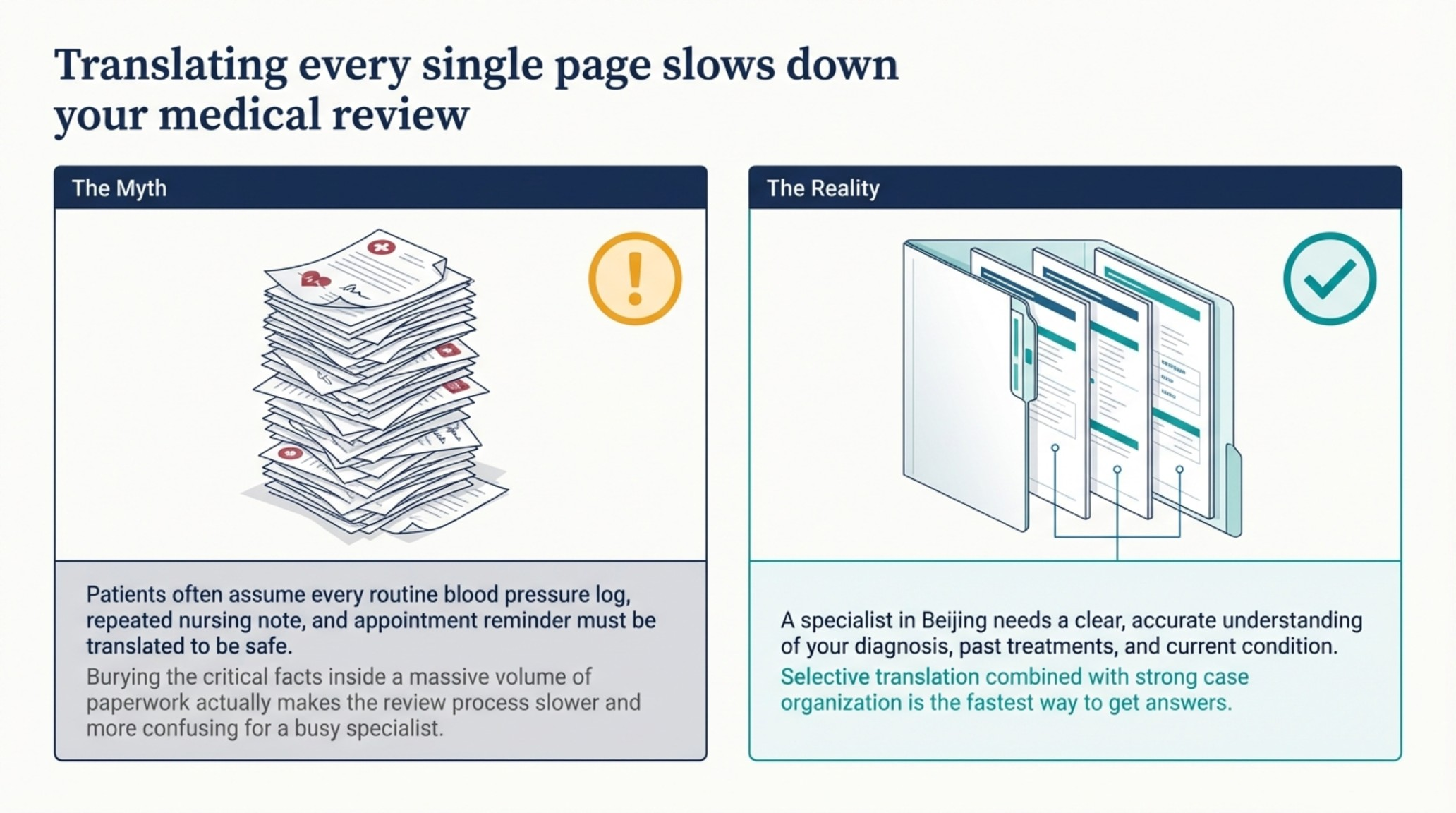
Many international patients assume that every page of their medical history must be translated into Chinese before a hospital can review their case. In reality, that is often unnecessary. What doctors usually need first is not a complete archive of every routine note or administrative record. They need a clear and accurate understanding of your diagnosis, the treatment you have already received, and your current condition.
That is why the most effective approach is usually not full-volume translation. It is selective translation combined with strong case organization. A well-prepared file can save time, reduce confusion, and make it much easier for a specialist in Beijing to understand your case quickly.
Why Translating Everything Is Not Always the Best Approach
It is completely understandable to want to be thorough. When you are facing a serious medical issue, translating everything can feel like the safest option.
But in many cases, translating every page is not the most efficient use of time or money.
Routine blood pressure logs, repeated nursing notes, appointment reminders, and other low-priority records often add very little value to an initial specialist review. A busy physician usually needs the key information first. If the most important facts are buried inside a large volume of translated material, the review process may actually become slower rather than easier.
For most patients, the goal should not be to translate more pages. The goal should be to help the medical team understand the case faster and more clearly.
Which Medical Records Should Be Translated First?
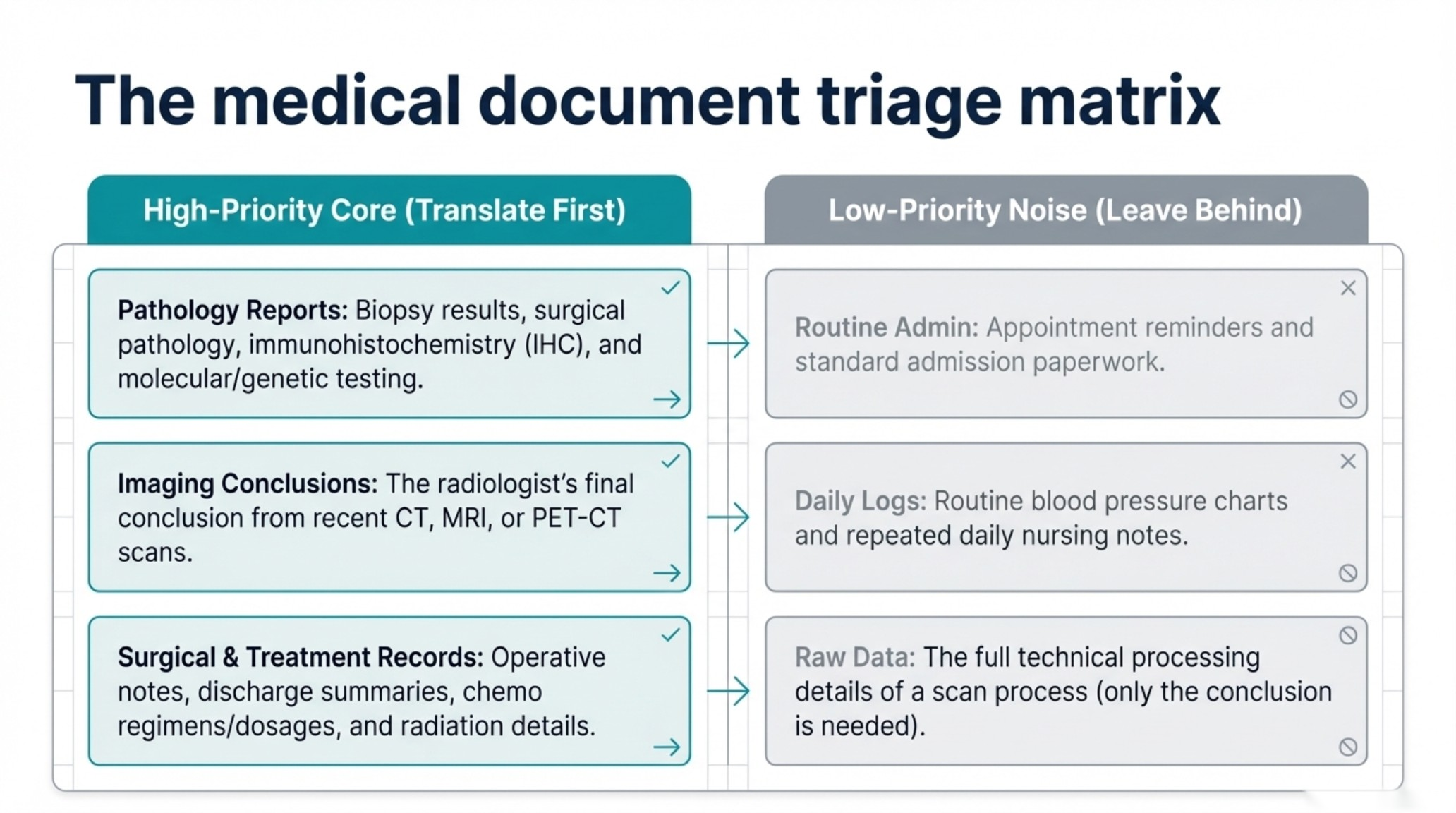
Instead of translating everything, it is usually better to focus on the core records that define the diagnosis, explain the treatment history, and show the current clinical question.
Medical Summary and Timeline
A concise medical summary is often the single most useful document in the entire file.
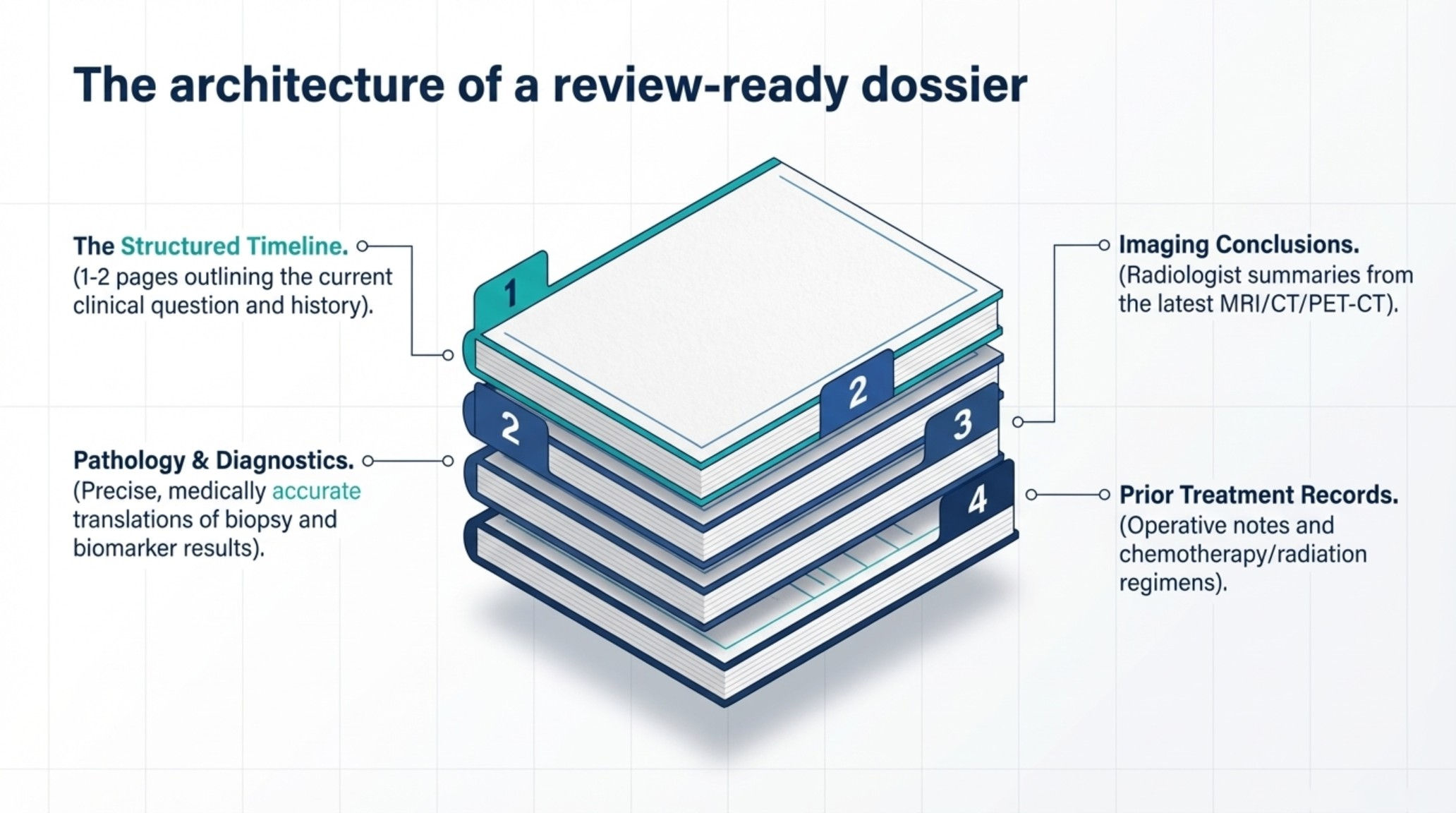
This summary should clearly show when symptoms began, when the diagnosis was made, what tests confirmed it, what treatments have already been tried, and what the current concern is. In many cases, a well-organized one- to two-page timeline gives a specialist a much faster understanding of the case than a large stack of translated documents without context.
Pathology Reports
If your diagnosis depends on tissue testing, pathology reports are usually among the highest-priority documents.
This may include biopsy results, surgical pathology, immunohistochemistry, and molecular or genetic testing. These records need careful translation because medical terminology in pathology is highly specific, and even small wording errors can create confusion during case review.
Imaging Conclusions
You usually do not need to translate every technical detail from the scan process itself. What matters most is the radiologist’s conclusion from the most relevant recent imaging, such as CT, MRI, or PET-CT.
These reports help the receiving doctor understand what the scan showed and how those findings may affect treatment planning.
Surgical and Treatment Records
If you have already had surgery, chemotherapy, radiation therapy, targeted therapy, immunotherapy, or another major intervention, the key treatment records should be understandable to the next physician.
This may include operative notes, discharge summaries, chemotherapy regimens and dosages, radiation details, and treatment response assessments. These records help the hospital team understand what has already been done and what may need to be considered next.
Why a Structured Summary Is Often More Useful Than Raw Copies
One common mistake is handing over a large set of translated documents without any clinical structure.
Even if every page is translated accurately, the file may still be difficult to review if the medical story is not organized clearly. A structured summary helps the specialist understand the case quickly by answering the most important questions first: What is the diagnosis? What has already been tried? What is the current issue? What decision is needed now?
Once those points are clear, the doctor can move to the supporting records for additional detail.
In other words, a strong summary does not replace the original reports. It makes the entire case easier to navigate.
Why Original English Reports May Not Be Enough
Some patients wonder whether translation is really necessary if their records are already in English.
In some top hospitals in Beijing, many specialists can read English medical documents. However, relying only on the original English reports is not always ideal. A case may be reviewed by more than one physician, entered into internal hospital systems, or handled by staff members who work more efficiently with Chinese-language records.
Having the key parts of the file translated into Chinese can help the review process move more smoothly across the wider hospital system, not just in the first conversation with a doctor.
Why Accuracy Matters in Medical Translation
Medical translation is not the same as everyday translation.
For important records, general translation tools or non-medical translators may not be reliable enough. Medical wording can be highly specific, and errors in terminology, abbreviations, staging, biomarkers, procedures, or drug names may lead to misunderstanding.
Depending on the case, inaccurate translation may create unnecessary back-and-forth communication, repeated clarification, duplicated testing, or delays in evaluation. The most important records should therefore be translated in a way that is medically accurate and clinically usable.
So, Do You Need to Translate Medical Records Before Treatment in China?
For most patients, the practical answer is yes—but with focus.
You usually do not need to translate every historical page. What you do need is a clear, well-organized case file that allows a China-based specialist to quickly understand your diagnosis, treatment history, current status, and the reason you are seeking further evaluation.
This is especially important if you are trying to obtain an initial review before travel, prepare for hospital intake, or reduce delays after arrival.
How PandaMed Can Help
Many patients do not need every page translated. They need the right parts reviewed, organized, and made easier for a Beijing specialist to understand.
If you are unsure which records matter for your case, PandaMed supports international patients traveling to Beijing by helping them prepare their files before hospital review. Depending on the diagnosis, disease status, and prior treatment history, the records needed may differ from one patient to another.
Through PandaMed’s Priority Assessment & Triage, patients can get help identifying the most relevant materials, organizing a clear medical timeline, coordinating translation of key documents, and preparing a more review-ready file for a Beijing specialist. PandaMed is not a hospital and does not provide diagnosis or treatment. Our role is to support international patients with case preparation, communication, and coordination before cross-border care.
If you would like help reviewing which documents to prepare before coming to China, you are welcome to contact PandaMed at contact@pandamedglobal.com.
Frequently Asked Questions
Can I just use Google Translate for my medical records?
Machine translation can be useful for basic communication, but it is often not reliable enough for core medical documents. Pathology, staging, biomarkers, treatment history, and medication details usually require more careful review and medically appropriate wording.
Should I translate my records before I contact a hospital in China?
In many cases, yes—at least the core summary and the most important diagnostic records. Hospitals generally need a clear understanding of your case before they can provide meaningful next-step feedback or begin an internal review process.
Do I need to translate prescription labels?
Usually, it is more useful to prepare a translated medication list that includes the generic drug name, dosage, and frequency. Translating every label on every bottle is not always necessary.
Will the hospital in China translate my records for me?
In many cases, incoming records are expected to be understandable at the time of review. Dedicated translation support for outside medical records is not always routinely available, so it is usually better to prepare the key materials in advance.
