
When Bracing Fails in Adolescent Idiopathic Scoliosis: Surgical Timing and Top Beijing Spine Centers
SEO Title: Adolescent Idiopathic Scoliosis Bracing Failure: Surgical Timelines and Expert Centers in Beijing
Your child has adolescent idiopathic scoliosis, and bracing is no longer controlling the curve. The Cobb angle keeps progressing, or wearing the brace for 18 to 23 hours a day has become too hard to sustain. When that happens, families need a clearer surgical plan, and Beijing’s top public spine centers may be worth understanding because they combine high-volume deformity surgery with faster access and a lower self-pay burden than many Western private-pay pathways.
Quick Decision Snapshot
| Decision Point | US / UK Typical Pathway | Top Beijing Public Hospitals |
|---|---|---|
| First-line treatment | Observation or bracing for growing adolescents with moderate curves | Same first-line principle, with earlier senior spine review once progression continues |
| Specialist wait time | Families often wait months for specialist review, and surgical waits commonly run 3 to 8 months | Senior deformity review can often be arranged faster, and surgery may move in 2 to 3 weeks when the case is already clearly surgical |
| Out-of-pocket cost | For self-pay families, scoliosis surgery can create a very high out-of-pocket burden in many Western private-pay settings | For comparable self-pay cases, Beijing public hospitals are often materially less expensive than typical US or UK private-pay pathways |
If you already have X-rays, MRI, brace records, or prior clinic notes, you can send what you have to contact@pandamedglobal.com. Old records are often enough for an initial records check, and we can tell you what to prepare next.
Why You Cannot Just "Wait and See"
Once bracing is clearly failing, timing matters. The issue is not only whether surgery is needed. It is whether delaying surgery could make the curve harder to treat, increase long-term risk, or reduce future spinal mobility.
Continued progression during bracing is a real warning sign
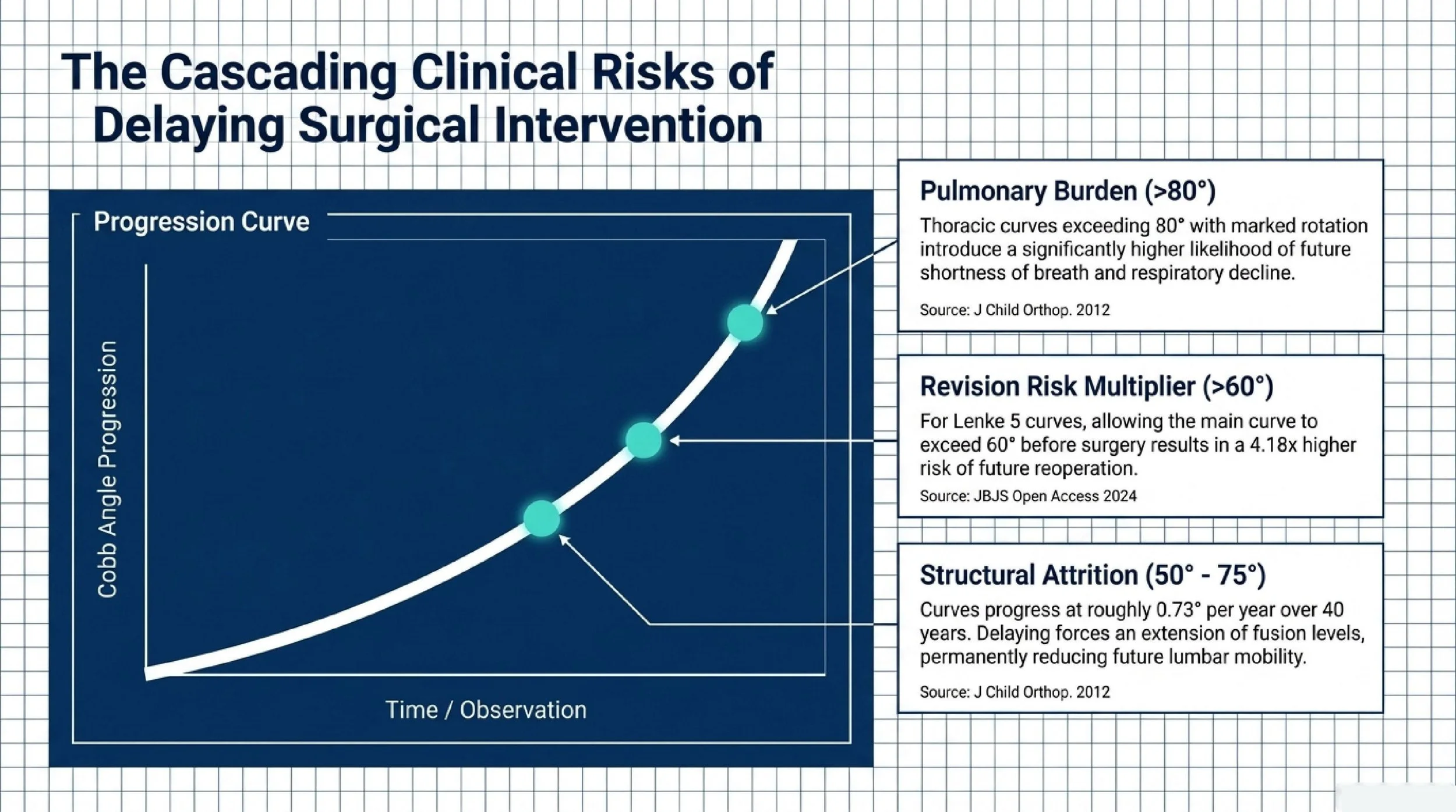
If the Cobb angle keeps progressing by more than 6° during bracing, or if the curve has already reached the usual 50° surgical threshold, continued observation becomes much harder to justify.
This is not rare. A systematic review and meta-analysis in Spine Deformity (2025) found that about 30% to 40% of adolescents treated with bracing still went on to need surgery by skeletal maturity. That does not mean bracing is ineffective overall. It means that once a curve keeps progressing despite treatment, families need to plan for the next step instead of assuming more time will solve the problem.
Larger thoracic curves can carry long-term pulmonary and structural risk
According to J Child Orthop. 2012, adolescent idiopathic scoliosis does not appear to raise overall mortality, but larger thoracic curves can still create meaningful long-term burden. When a thoracic curve exceeds 80° and shows marked rotation, future shortness of breath becomes much more likely, and quality of life may decline.
That same study showed that single thoracic curves between 50° and 75° can continue to progress at about 0.73° per year over 40 years. In practical terms, that means a teenager who reaches adulthood with a surgical-range curve may still gain another 20 to 30 degrees by later adult life.
That is one reason surgeons do not simply look at the current number. They also consider what that number is likely to become.
Delay can mean a bigger operation and a higher revision risk
Earlier surgery may allow a more focused correction strategy, including selective thoracic fusion in suitable patients, which can help preserve more lumbar mobility. If surgery is delayed and the deformity progresses further, fusion levels may need to extend. That can limit motion more than families expected at the start.
Delay may also affect revision risk. A JBJS Open Access (2024) study reported that for Lenke 5 curves, when the main curve exceeds 60°, the risk of reoperation after posterior spinal fusion rises by 4.18 times.
So the downside of waiting is not just a larger Cobb angle. It may change the operation itself.
Long-term quality of life after surgery is often better than families fear
Many parents worry that surgery will solve one problem but create another. That concern is understandable. But the longer-term data are often more reassuring than families expect.
A 10-year follow-up study in Maedica (Bucur). 2025 found that after corrective AIS surgery, the mean SRS-22 total score was 4.5 out of 5, and the mean pain score was 4.6 out of 5. These findings suggest sustained improvement in pain, function, and overall quality of life over time. By contrast, untreated adults with scoliosis tend to report higher rates of back pain.
No article can tell an individual family what decision to make. But these data do support that, in the right case, surgery is not only about cosmetic correction. It can be a long-term functional decision.
Why high-volume Beijing centers may matter
If surgery is needed, families usually want a team that handles scoliosis deformity work every week, not occasionally.
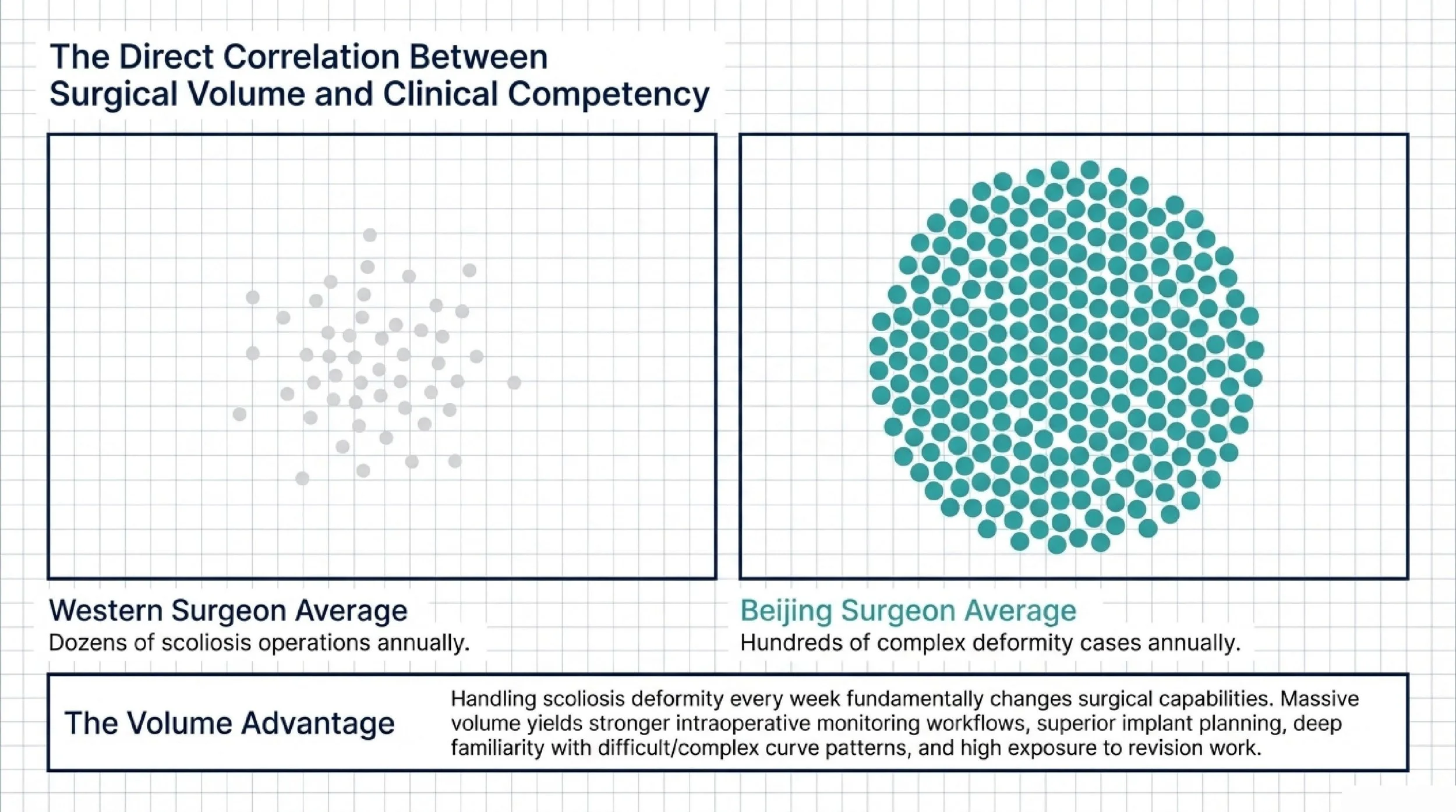
In many Western settings, even strong spine surgeons may perform only dozens of scoliosis operations a year. In contrast, top Beijing tertiary centers report much larger spine surgery volumes, and senior surgeons in these systems may participate in hundreds of complex deformity cases annually.
That matters because high-volume programs often have stronger intraoperative monitoring workflows, more experience with implant planning, more familiarity with difficult curve patterns, and more surgical exposure to revision or complex deformity work.
Two Beijing hospitals especially relevant here are:
Beijing Jishuitan Hospital
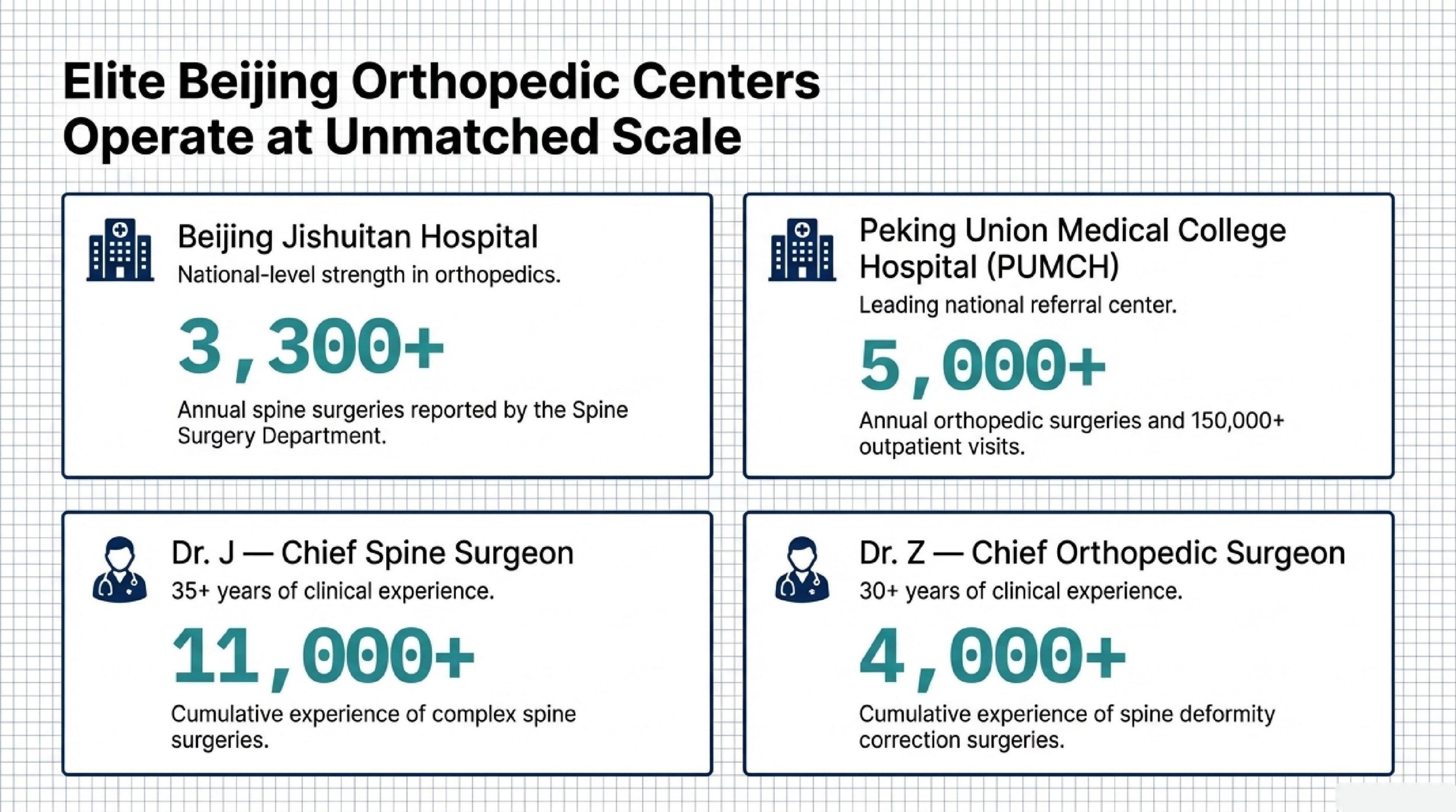
Beijing Jishuitan Hospital is one of China’s best-known orthopedic hospitals and is widely recognized for national-level strength in orthopedics. Its Spine Surgery Department reports 3,300+ annual spine surgeries. Plain-text attribution: Beijing Jishuitan Hospital official description.
Peking Union Medical College Hospital (PUMCH)
PUMCH is one of China’s leading national referral centers. Its orthopedic department reports 5,000+ annual surgeries and 150,000+ outpatient visits, with major experience in complex spine disease and advanced spine techniques. Plain-text attribution: Peking Union Medical College Hospital official description.
Representative senior surgeon profiles may include:
Dr. J
Chief spine surgeon at a top Beijing orthopedic center. 35+ years of experience. Reported cumulative experience of 11,000+ complex spine surgeries. Plain-text attribution: hospital description and public expert biography materials provided in the source draft.
Dr. Z
Chief orthopedic surgeon at a national-level Beijing hospital. 30+ years of experience. Reported cumulative experience of 4,000+ spine deformity correction surgeries. Plain-text attribution: hospital description and public expert biography materials provided in the source draft.
If your child’s case is complex, or if you are not sure whether the current X-rays, MRI, or prior brace records are enough, you can email what you already have to contact@pandamedglobal.com. Old records are often enough for an initial records review, and we can help explain what to prepare next.
The Checklist
You do not need to wait for brand-new tests before asking what to prepare. In many cases, existing records are often enough to start.
For AIS bracing failure, the most useful records usually include:
Standing full-spine X-rays in AP and lateral views
Bending films if they have already been done
Most recent MRI if there are neurologic symptoms or if MRI has already been completed
Original DICOM files, ideally on CD or cloud link
Growth maturity data, including Risser sign
Menarche timing for female patients
Left hand and wrist bone-age film if available
Brace treatment history, including brace type such as Boston brace or night brace
Daily wear time and any compliance-tracking data
All Cobb angle measurements recorded during bracing
Pulmonary function testing if the Cobb angle is greater than 60°
Prior clinic notes, discharge summaries, or operative notes if any exist
For many families, the first useful step is not repeating everything. It is organizing what they already have so a senior spine team can review the case more efficiently.
Family and Beijing Logistics
If you are traveling with family, or trying to understand visas, lodging, appointment flow, translation, hospital navigation, or Beijing care coordination, you can email contact@pandamedglobal.com. We can also help explain what usually needs to be prepared first before a Beijing spine review.
Author Bio
Ryan Lee is a Beijing-based medical concierge and the founder of PandaMed. With a strict compliance background, he helps international patients navigate China's top public hospitals safely. He secures direct access to Chief Physicians for complex cases.
Medical Disclaimer
This information is for educational purposes only and is not medical advice. PandaMed is a care coordination service, not a medical provider. Always consult a qualified doctor for your specific condition.
References
Spine Deform. 2025. Bracing effectiveness in idiopathic early onset scoliosis followed to skeletal maturity: a systematic review and meta-analysis.
J Child Orthop. 2012. Natural history of adolescent idiopathic scoliosis: a tool for guidance in decision of surgery of curves above 50°.
JBJS Open Access. 2024. Reoperation Rate After Posterior Spinal Fusion Varies Significantly by Lenke Type.
Maedica (Bucur). 2025. Long-term Life-Quality Outcomes after Corrective Adolescent Idiopathic Scoliosis Surgery: 10-Year Postoperative Assessment Comparing Lenke Classification and Fused Levels.
CLEAR Scoliosis Institute (2024/2025 Cost Analysis). Plain-text attribution for comparative Western self-pay cost framing provided in source draft.
2025年《中国卫生健康统计年鉴》. Plain-text attribution for estimated China-side cost context provided in source draft.
